






 9C5Z
9C5Z
Structure of Ligand binding and transmembrane domains of kainate receptor Gluk2 in apo state
Summary for 9C5Z
| Entry DOI | 10.2210/pdb9c5z/pdb |
| EMDB information | 45238 |
| Descriptor | Glutamate receptor ionotropic, kainate 2, 2-acetamido-2-deoxy-beta-D-glucopyranose (2 entities in total) |
| Functional Keywords | c1, membrane, glutamate, synapse, structural protein |
| Biological source | Rattus norvegicus (Norway rat) |
| Total number of polymer chains | 4 |
| Total formula weight | 411663.37 |
| Authors | Changping, Z.,Nami, T. (deposition date: 2024-06-07, release date: 2025-07-02, Last modification date: 2026-01-14) |
| Primary citation | Segura-Covarrubias, G.,Zhou, C.,Bogdanovic, N.,Zhang, L.,Tajima, N. Structural basis of GluK2 kainate receptor activation by a partial agonist. Nat.Struct.Mol.Biol., 32:1456-1469, 2025 Cited by PubMed Abstract: Kainate receptors (KARs) belong to the family of ionotropic glutamate receptors that regulate neurotransmitter release and excitatory synaptic transmission in the central nervous system. Despite their critical roles in synaptic signaling and disease, the detailed gating mechanisms of KARs are not completely understood. Here we present cryo-electron microscopy structures of homomeric rat GluK2 KAR in an unliganded apo state and in complexes with a partial agonist, domoate. Partial agonist-bound GluK2 populates multiple conformations, including intermediate and desensitized states. Moreover, we demonstrate that the N-glycans at the amino-terminal domain-ligand binding domain (LBD) interface modulate receptor gating properties by interfering with cation binding at the LBD dimer interface. Together, these results provide insights into the unique gating mechanisms of KARs. PubMed: 40442317DOI: 10.1038/s41594-025-01566-w PDB entries with the same primary citation |
| Experimental method | ELECTRON MICROSCOPY (3.63 Å) |
Structure validation
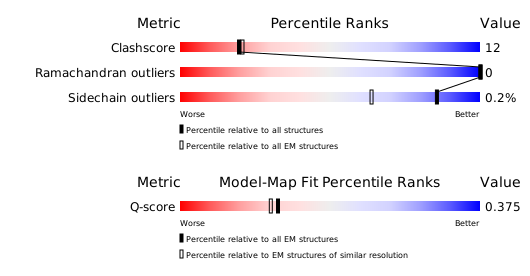
Download full validation report


