






 9C14
9C14
Structure of the CopC-like domain of YcnJ
Summary for 9C14
| Entry DOI | 10.2210/pdb9c14/pdb |
| Descriptor | Copper transport protein YcnJ, SULFATE ION, TRIETHYLENE GLYCOL, ... (4 entities in total) |
| Functional Keywords | copper import, copc, ycnj, extracellular domain, metal binding protein |
| Biological source | Bacillus subtilis (strain 168) |
| Total number of polymer chains | 1 |
| Total formula weight | 11265.49 |
| Authors | de Oliveira Silva, Y.R.,Zheng, D.,Fisher, O.S. (deposition date: 2024-05-28, release date: 2025-08-06, Last modification date: 2025-08-20) |
| Primary citation | de Oliveira Silva, Y.R.,Barnes, G.,Zheng, D.,Zhitnitsky, D.,Geathers, S.J.,Peters, S.C.,Szalai, V.A.,Helmann, J.D.,Fisher, O.S. Copper acquisition in Bacillus subtilis involves Cu(II) exchange between YcnI and YcnJ. J.Biol.Chem., 301:110480-110480, 2025 Cited by PubMed Abstract: The transition metal copper (Cu) is biologically essential across all three domains of life. Several Cu-dependent proteins and enzymes produced by the Gram-positive bacterium Bacillus subtilis have been characterized. However, many questions remain about how Cu is recognized and trafficked to metalate cuproproteins. The ycnKJI operon in B. subtilis encodes a suite of proteins implicated in Cu uptake and regulation, including the Cu-binding protein YcnI and the putative Cu importer YcnJ. Here, we demonstrate that one of the extracellular domains within YcnJ (YcnJ) binds Cu(II) in 1:1 stoichiometry with high affinity using a histidine brace motif. Biochemical results reveal that YcnJ and YcnI can exchange Cu(II). Genetic studies reveal that loss of either YcnI or YcnJ, or mutation of the key residues required for Cu(II) binding, leads to a growth defect under conditions of Cu limitation. Together, these data suggest that the Cu(II)-binding sites in both YcnI and YcnJ may contribute to efficient import under Cu-limited conditions. Our results support a model in which YcnI may sequester Cu(II) from YcnJ, serving a regulatory role to limit the amount of Cu that enters the cytoplasm and allowing Cu(II) to be stored for later import on the outer face of the membrane. This transfer of Cu(II) between extracellular domains of membrane-bound proteins represents a potential new paradigm in bacterial Cu usage. PubMed: 40669668DOI: 10.1016/j.jbc.2025.110480 PDB entries with the same primary citation |
| Experimental method | X-RAY DIFFRACTION (1.6 Å) |
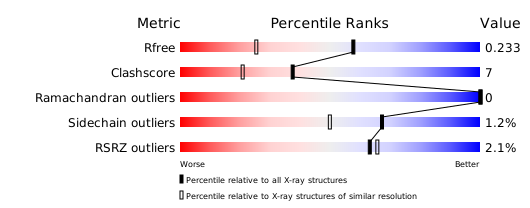
Structure validation
Download full validation report


