






 9C0W
9C0W
AzrC from Bacillus pacificus ROC1 bound to malachite green
Summary for 9C0W
| Entry DOI | 10.2210/pdb9c0w/pdb |
| Descriptor | FMN-dependent NADH:quinone oxidoreductase 3, FLAVIN MONONUCLEOTIDE, MALACHITE GREEN, ... (4 entities in total) |
| Functional Keywords | azoreductase, fmn, malachite green, flavoprotein |
| Biological source | Bacillus pacificus |
| Total number of polymer chains | 2 |
| Total formula weight | 51768.73 |
| Authors | Breeze, C.W.,Jackson, C.J.,Frkic, R.L. (deposition date: 2024-05-28, release date: 2025-02-05, Last modification date: 2025-02-12) |
| Primary citation | Bibi, S.,Breeze, C.W.,Jadoon, V.,Fareed, A.,Syed, A.,Frkic, R.L.,Zaffar, H.,Ali, M.,Zeb, I.,Jackson, C.J.,Naqvi, T.A. Isolation, identification, and characterisation of the malachite green detoxifying bacterial strain Bacillus pacificus ROC1 and the azoreductase AzrC. Sci Rep, 15:3499-3499, 2025 Cited by PubMed Abstract: Malachite green (MG) is used as a dye for materials such as wood, cotton, and nylon, and is used in aquaculture to prevent fungal and protozoan diseases. However, it is highly toxic, with carcinogenic, mutagenic, and teratogenic properties, resulting in bans worldwide. Despite this, MG is still frequently used in many countries due to its efficacy and economy. MG is persistent in the environment and so requires degradative intervention. In this work we isolated Bacillus pacificus ROC1 strain from a salt flat in Pakistan that had the ability to aerobically detoxify MG, as determined by bacterio- and phyto-toxicity assays. We demonstrate immobilized B. pacificus ROC1 can effectively detoxify MG, which highlights a potential method for its biodegradation. Genomic sequencing identified three candidate azo-reductases within B. pacificus ROC1 that could be responsible for the MG-degrading activity. These were cloned, expressed and purified from Escherichia coli, with one (AzrC), catalyzing the reduction of MG to leuco-MG in vitro. AzrC was crystallised and MG was captured within the active site in a Michaelis complex, providing structural insight into the reduction mechanism. Altogether, this work identifies a bacterium capable of aerobically degrading a major industrial pollutant and characterizes the molecular basis for this activity. PubMed: 39875461DOI: 10.1038/s41598-024-84609-4 PDB entries with the same primary citation |
| Experimental method | X-RAY DIFFRACTION (2.35 Å) |
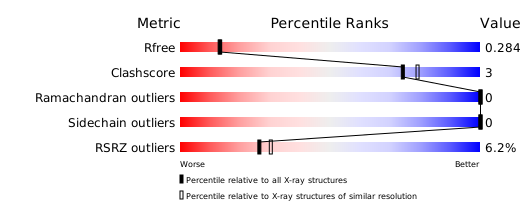
Structure validation
Download full validation report


