






 9BVO
9BVO
Vitamin K-dependent gamma-carboxylase in apo state
Summary for 9BVO
| Entry DOI | 10.2210/pdb9bvo/pdb |
| EMDB information | 44939 |
| Descriptor | Vitamin K-dependent gamma-carboxylase, 2-acetamido-2-deoxy-beta-D-glucopyranose-(1-4)-2-acetamido-2-deoxy-beta-D-glucopyranose, (4S,7R)-4-HYDROXY-N,N,N-TRIMETHYL-9-OXO-7-[(PALMITOYLOXY)METHYL]-3,5,8-TRIOXA-4-PHOSPHAHEXACOSAN-1-AMINIUM 4-OXIDE, ... (4 entities in total) |
| Functional Keywords | ggcx, vkgc, vitamin k, vkcfd, hemophilia b, warfarin, carboxylation, blood coagulaton, calcium homeostasis, membrane protein, lyase |
| Biological source | Homo sapiens (human) |
| Total number of polymer chains | 1 |
| Total formula weight | 87263.19 |
| Authors | |
| Primary citation | Cao, Q.,Ammerman, A.,Saimi, M.,Lin, Z.,Shen, G.,Chen, H.,Sun, J.,Chai, M.,Liu, S.,Hsu, F.F.,Krezel, A.M.,Gross, M.L.,Xu, J.,Garcia, B.A.,Liu, B.,Li, W. Molecular basis of vitamin-K-driven gamma-carboxylation at the membrane interface. Nature, 639:816-824, 2025 Cited by PubMed Abstract: The γ-carboxylation of glutamate residues enables Ca-mediated membrane assembly of protein complexes that support broad physiological functions, including haemostasis, calcium homeostasis, immune response and endocrine regulation. Modulating γ-carboxylation levels provides prevalent treatments for haemorrhagic and thromboembolic diseases. This unique post-translational modification requires vitamin K hydroquinone (KH) to drive highly demanding reactions catalysed by the membrane-integrated γ-carboxylase (VKGC). Here, to decipher the underlying mechanisms, we determined cryo-electron microscopy structures of human VKGC in unbound form, with KH and four haemostatic and non-haemostatic proteins possessing propeptides and glutamate-rich domains in different carboxylation states. VKGC recognizes substrate proteins through knob-and-hole interactions with propeptides, thereby bringing tethered glutamate-containing segments for processive carboxylation within a large chamber that provides steric control. Propeptide binding also triggers a global conformational change to signal VKGC activation. Through sequential deprotonation and KH epoxidation, VKGC generates a free hydroxide ion as an exceptionally strong base that is required to deprotonate the γ-carbon of glutamate for CO addition. The diffusion of this superbase-protected and guided by a sealed hydrophobic tunnel-elegantly resolves the challenge of coupling KH epoxidation to γ-carboxylation across the membrane interface. These structural insights and extensive functional experiments advance membrane enzymology and propel the development of treatments for γ-carboxylation disorders. PubMed: 39880037DOI: 10.1038/s41586-025-08648-1 PDB entries with the same primary citation |
| Experimental method | ELECTRON MICROSCOPY (4.4 Å) |
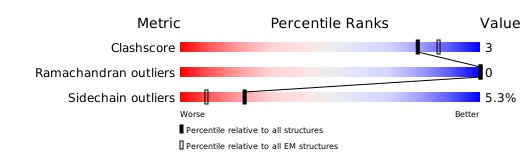
Structure validation
Download full validation report


