






 9BFK
9BFK
Cryo-EM structure of human CHT1 in the ML352 bound state
This is a non-PDB format compatible entry.
Summary for 9BFK
| Entry DOI | 10.2210/pdb9bfk/pdb |
| EMDB information | 44499 |
| Descriptor | High affinity choline transporter 1, 4-methoxy-3-[(1-methylpiperidin-4-yl)oxy]-N-{[3-(propan-2-yl)-1,2-oxazol-5-yl]methyl}benzamide (2 entities in total) |
| Functional Keywords | choline transporter, transport protein |
| Biological source | Homo sapiens (human) |
| Total number of polymer chains | 1 |
| Total formula weight | 66914.10 |
| Authors | |
| Primary citation | Xue, J.,Chen, H.,Wang, Y.,Jiang, Y. Structural mechanisms of human sodium-coupled high-affinity choline transporter CHT1. Cell Discov, 10:116-116, 2024 Cited by PubMed Abstract: Mammalian sodium-coupled high-affinity choline transporter CHT1 uptakes choline in cholinergic neurons for acetylcholine synthesis and plays a critical role in cholinergic neurotransmission. Here, we present the high-resolution cryo-EM structures of human CHT1 in apo, substrate- and ion-bound, hemicholinium-3-inhibited, and ML352-inhibited states. These structures represent three distinct conformational states, elucidating the structural basis of the CHT1-mediated choline uptake mechanism. Three ion-binding sites, two for Na and one for Cl, are unambiguously defined in the structures, demonstrating that both ions are indispensable cofactors for high-affinity choline-binding and are likely transported together with the substrate in a 2:1:1 stoichiometry. The two inhibitor-bound CHT1 structures reveal two distinct inhibitory mechanisms and provide a potential structural platform for designing therapeutic drugs to manipulate cholinergic neuron activity. Combined with the functional analysis, this study provides a comprehensive view of the structural mechanisms underlying substrate specificity, substrate/ion co-transport, and drug inhibition of a physiologically important symporter. PubMed: 39587078DOI: 10.1038/s41421-024-00731-7 PDB entries with the same primary citation |
| Experimental method | ELECTRON MICROSCOPY (2.85 Å) |
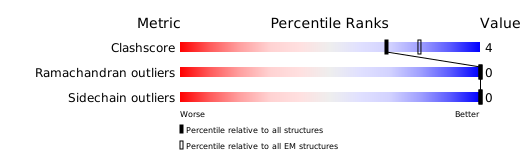
Structure validation
Download full validation report


