






 9BD8
9BD8Summary for 9BD8
| Entry DOI | 10.2210/pdb9bd8/pdb |
| EMDB information | 44446 |
| Descriptor | Apolipoprotein B-100, Low-density lipoprotein receptor, 2-acetamido-2-deoxy-beta-D-glucopyranose (3 entities in total) |
| Functional Keywords | ldl, low density lipoprotein, ldl receptor, lipid transport |
| Biological source | Homo sapiens (human) More |
| Total number of polymer chains | 2 |
| Total formula weight | 611865.70 |
| Authors | Dearborn, A.D.,Reimund, M.,Graziano, G.,Lei, H.,Kumar, A.,Neufeld, E.B.,Remaley, A.T.,Marcotrigiano, J. (deposition date: 2024-04-11, release date: 2024-12-25, Last modification date: 2025-03-05) |
| Primary citation | Reimund, M.,Dearborn, A.D.,Graziano, G.,Lei, H.,Ciancone, A.M.,Kumar, A.,Holewinski, R.,Neufeld, E.B.,O'Reilly, F.J.,Remaley, A.T.,Marcotrigiano, J. Structure of apolipoprotein B100 bound to the low-density lipoprotein receptor. Nature, 638:829-835, 2025 Cited by PubMed Abstract: Apolipoprotein B100 (apoB100) is a structural component of low-density lipoprotein (LDL) and a ligand for the LDL receptor (LDLR). Mutations in apoB100 or in LDLR cause familial hypercholesterolaemia, an autosomal dominant disease that is characterized by a marked increase in LDL cholesterol (LDL-C) and a higher risk of cardiovascular disease. The structure of apoB100 on LDL and its interaction with LDLR are poorly understood. Here we present the cryo-electron microscopy structures of apoB100 on LDL bound to the LDLR and a nanobody complex, which can form a C-symmetric, higher-order complex. Using local refinement, we determined high-resolution structures of the interfaces between apoB100 and LDLR. One binding interface is formed between several small-ligand-binding modules of LDLR and a series of basic patches that are scattered along a β-belt formed by apoB100, encircling LDL. The other binding interface is formed between the β-propeller domain of LDLR and the N-terminal domain of apoB100. Our results reveal how both interfaces are involved in LDL dimer formation, and how LDLR cycles between LDL- and self-bound conformations. In addition, known mutations in either apoB100 or LDLR, associated with high levels of LDL-C, are located at the LDL-LDLR interface. PubMed: 39663455DOI: 10.1038/s41586-024-08223-0 PDB entries with the same primary citation |
| Experimental method | ELECTRON MICROSCOPY (4.8 Å) |
Structure validation
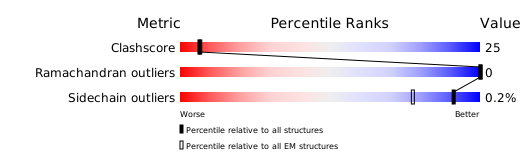
Download full validation report


