






 9AZU
9AZU
Crystal structure of PDC-3 beta-lactamase in complex with taniborbactam
Summary for 9AZU
| Entry DOI | 10.2210/pdb9azu/pdb |
| Descriptor | Beta-lactamase, (3~{R})-3-[2-[4-(2-azanylethylamino)cyclohexyl]ethanoylamino]-2-oxidanyl-3,4-dihydro-1,2-benzoxaborinine-8-carboxylic acid (3 entities in total) |
| Functional Keywords | beta-lactamase, boronic acid inhibitor, hydrolase-antibiotic complex, hydrolase/antibiotic |
| Biological source | Pseudomonas aeruginosa |
| Total number of polymer chains | 1 |
| Total formula weight | 43808.45 |
| Authors | Kumar, V.,van den Akker, F. (deposition date: 2024-03-11, release date: 2025-03-19, Last modification date: 2025-07-09) |
| Primary citation | Mack, A.R.,Kumar, V.,Bethel, C.R.,Taracila, M.A.,Miller, B.A.,Uehara, T.,Six, D.A.,Papp-Wallace, K.M.,van den Akker, F.,Bonomo, R.A. Structure and mechanism of taniborbactam inhibition of the cefepime-hydrolyzing, partial R2-loop deletion Pseudomonas -derived cephalosporinase variant PDC-88. Antimicrob.Agents Chemother., 69:e0007825-e0007825, 2025 Cited by PubMed Abstract: is a major gram-negative pathogen responsible for a variety of infections and possessing an array of both intrinsic and acquired resistance mechanisms, including β-lactamases, like the chromosomal -derived cephalosporinase (PDC). β-Lactams are the most widely prescribed class of antibiotics in the United States, and antipseudomonal cephalosporins (including cefepime) are important therapies (alone or combined with β-lactamase inhibitors) for infections. Taniborbactam is a novel, bicyclic boronate β-lactamase inhibitor with activity against all β-lactamase classes and is being developed in combination with cefepime. PDC-88 is an R2-loop deletion variant conferring resistance to cefepime and ceftazidime and elevating ceftolozane/tazobactam minimum inhibitory concentration (MIC). Herein, we elucidated PDC-88 resistance mechanisms and compared inhibition by taniborbactam and avibactam. In an isogenic background, PDC-88 increased cefepime MICs by 16-fold compared to PDC-3. , compared to PDC-3, PDC-88 had 8.3-fold higher catalytic efficiency for cefepime achieved by decreasing 12.8-fold and decreasing 1.6-fold. This is supported by our crystallographic observation that the PDC-88 deletion enlarged the active site in the vicinity of the R2-loop, likely better accommodating cefepime. Taniborbactam and avibactam restored cefepime activity by inhibiting PDC-88. Compared to avibactam, taniborbactam had 4.1- and 9-fold lower values for PDC-3 and PDC-88, respectively, with higher (/) and similar for both enzymes. Structurally, taniborbactam positioned very similarly in the PDC-3 and PDC-88 active sites, interacting with many nearby residues. Based upon these data, cefepime-taniborbactam may represent an important alternative to ceftazidime-avibactam and ceftolozane-tazobactam for infections. PubMed: 40503958DOI: 10.1128/aac.00078-25 PDB entries with the same primary citation |
| Experimental method | X-RAY DIFFRACTION (1.73 Å) |
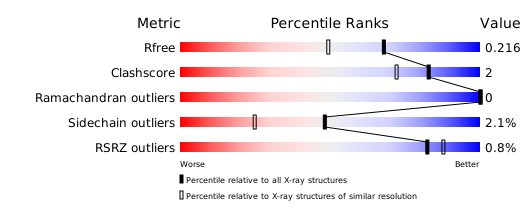
Structure validation
Download full validation report


