






 9ATL
9ATL
Cryo-EM of Stenotrophomonas maltophilia flagellum
Summary for 9ATL
| Entry DOI | 10.2210/pdb9atl/pdb |
| EMDB information | 43830 |
| Descriptor | Flagellin (1 entity in total) |
| Functional Keywords | flagellum, flagellar filament, filament, helical symmetry, protein fibril |
| Biological source | Stenotrophomonas maltophilia |
| Total number of polymer chains | 11 |
| Total formula weight | 441643.73 |
| Authors | Fields, J.L.,Zhang, H.,Halder, S.K.,Wu, H.,Wang, F. (deposition date: 2024-02-27, release date: 2024-11-13, Last modification date: 2025-05-28) |
| Primary citation | Fields, J.L.,Zhang, H.,Bellis, N.F.,Petersen, H.A.,Halder, S.K.,Rich-New, S.T.,Krupovic, M.,Wu, H.,Wang, F. Structural diversity and clustering of bacterial flagellar outer domains. Nat Commun, 15:9500-9500, 2024 Cited by PubMed Abstract: Supercoiled flagellar filaments function as mechanical propellers within the bacterial flagellum complex, playing a crucial role in motility. Flagellin, the building block of the filament, features a conserved inner D0/D1 core domain across different bacterial species. In contrast, approximately half of the flagellins possess additional, highly divergent outer domain(s), suggesting varied functional potential. In this study, we report atomic structures of flagellar filaments from three distinct bacterial species: Cupriavidus gilardii, Stenotrophomonas maltophilia, and Geovibrio thiophilus. Our findings reveal that the flagella from the facultative anaerobic G. thiophilus possesses a significantly more negatively charged surface, potentially enabling adhesion to positively charged minerals. Furthermore, we analyze all AlphaFold predicted structures for annotated bacterial flagellins, categorizing the flagellin outer domains into 682 structural clusters. This classification provides insights into the prevalence and experimental verification of these outer domains. Remarkably, two of the flagellar structures reported herein belong to a distinct cluster, indicating additional opportunities on the study of the functional diversity of flagellar outer domains. Our findings underscore the complexity of bacterial flagellins and open up possibilities for future studies into their varied roles beyond motility. PubMed: 39489766DOI: 10.1038/s41467-024-53923-w PDB entries with the same primary citation |
| Experimental method | ELECTRON MICROSCOPY (3.26 Å) |
Structure validation
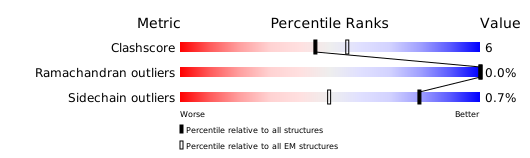
Download full validation report


