






 9WPB
9WPB
Crystal structure of human transthyretin (TTR) with pryazole-based stabilizer
This is a non-PDB format compatible entry.
Summary for 9WPB
| Entry DOI | 10.2210/pdb9wpb/pdb |
| Descriptor | Transthyretin, 4-[2-[3,5-bis(chloranyl)-1~{H}-pyrazol-4-yl]ethyl]benzoic acid (3 entities in total) |
| Functional Keywords | transthyretin, hydroxyisourate hydrolase, kinetic stabilizer, transport protein |
| Biological source | Homo sapiens (human) |
| Total number of polymer chains | 8 |
| Total formula weight | 113970.55 |
| Authors | |
| Primary citation | Kim, K.A.,Lee, C.,Lim, N.,Kim, K.W.,Lee, Y.H.,Choe, J.,Kim, S.J.,Jeong, J.W.,Jeon, E.H.,Son, D.H.,Park, S.J.,Kang, N.S.,Shin, H.C.,Koo, T.S.,Choi, S. Pyrazole-Based Transthyretin Kinetic Stabilizers Identified Using a Covalent Fluorescent Probe Assay for Selectivity Profiling in Human Serum. J.Med.Chem., 68:26448-26465, 2025 Cited by PubMed Abstract: Transthyretin (TTR) amyloidosis arises from the extracellular aggregation of misfolded TTR monomers into β-sheet-rich fibrils, leading to progressive tissue damage. To inhibit this process, we designed and synthesized pyrazole-based kinetic stabilizers targeting the thyroxine-binding sites of TTR. Structure-activity relationship studies revealed that derivatives with hydrophobic trans-alkene linkers and 3,5-substituted pyrazole rings showed enhanced stabilizing potency, particularly those bearing carboxylic acid, amide, or sulfonamide groups. A covalent fluorescent probe derived from trans-styrylpyrazole was developed to selectively react with Lys15, enabling fluorescence probe exclusion and native PAGE assays to evaluate stabilizer selectivity in human serum. Among these, 3,5-dichloropyrazole derivatives exhibited efficacy comparable to that of tafamidis and acoramidis. X-ray crystallography of the TTR- complex confirmed hydrogen bonding with Ser117/117' and electrostatic interactions with Lys15. Pharmacokinetic studies of compounds and demonstrated favorable exposure, bioavailability, and metabolic stability, supporting their preclinical development for hereditary- and wild-type TTR amyloidosis. PubMed: 41362238DOI: 10.1021/acs.jmedchem.5c02576 PDB entries with the same primary citation |
| Experimental method | X-RAY DIFFRACTION (1.58 Å) |
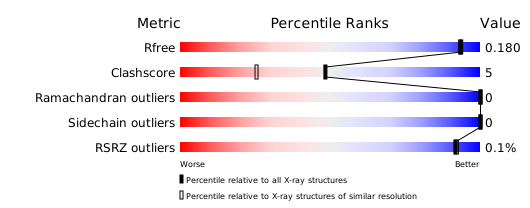
Structure validation
Download full validation report


