






 9S9C
9S9C
Crystal structure of the apo BRL2 ectodomain from Arabidopsis thaliana.
Summary for 9S9C
| Entry DOI | 10.2210/pdb9s9c/pdb |
| Related | 3RIZ 4J0M 9S80 |
| Descriptor | Serine/threonine-protein kinase BRI1-like 2, 2-acetamido-2-deoxy-beta-D-glucopyranose-(1-4)-2-acetamido-2-deoxy-beta-D-glucopyranose, 2-acetamido-2-deoxy-beta-D-glucopyranose-(1-4)-[alpha-L-fucopyranose-(1-6)]2-acetamido-2-deoxy-beta-D-glucopyranose, ... (5 entities in total) |
| Functional Keywords | receptor kinase, steroid receptor, brassinosteroids, leucine-rich repeat, membrane protein |
| Biological source | Arabidopsis thaliana (thale cress) |
| Total number of polymer chains | 1 |
| Total formula weight | 83035.58 |
| Authors | Caregnato, A.,Hothorn, M. (deposition date: 2025-08-06, release date: 2025-09-03, Last modification date: 2026-08-19) |
| Primary citation | Caregnato, A.,Chen, H.,Kvasnica, M.,Hohmann, U.,Oklestkova, J.,Ferrer, K.,Broger, L.,Hothorn, L.A.,Strnad, M.,Hothorn, M. A mechanistic framework for the recognition of chemically diverse brassinosteroids by BRI1-family receptor kinases. Nat.Plants, 2026 Cited by PubMed Abstract: Brassinosteroids (BRs) are chemically diverse plant steroid hormones produced via a branched biosynthetic pathway. The potent BR brassinolide is sensed by the membrane receptor kinase BRI1 and a SERK co-receptor, but the physiological functions of other abundant BRs remain to be characterized. Here we present quantitative binding kinetics for 4 Arabidopsis thaliana BR receptors and 15 BRs, which define the key chemical features required for high-affinity receptor binding, ligand positioning and co-receptor recognition. BRI1, BRL1 and BRL3 share overlapping ligand preferences, whereas BRL2 binds C BRs with moderate affinity. Structural analyses of BR-bound BRI1 and BRL3 ectodomains combined with extensive in vitro and in vivo mutagenesis studies reveal a high structural plasticity of the hormone-binding pocket. Functional assays using structure-based BR agonists and antagonists uncover that BR receptor-co-receptor signalling complexes can recognize chemically diverse BRs, introducing an additional, intriguing layer of BR signalling regulation. PubMed: 42557407DOI: 10.1038/s41477-026-02346-0 PDB entries with the same primary citation |
| Experimental method | X-RAY DIFFRACTION (2.59 Å) |
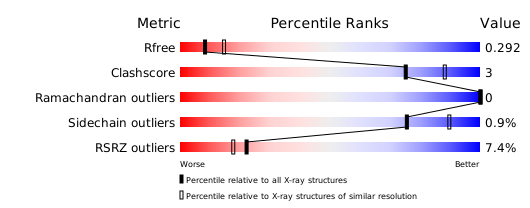
Structure validation
Download full validation report


