






 9QEK
9QEK
Structure of Human ROS1 Kinase Domain Harboring the G2032R Solvent-front Mutation in Complex with Zidesamtinib (NVL-520)
This is a non-PDB format compatible entry.
Summary for 9QEK
| Entry DOI | 10.2210/pdb9qek/pdb |
| Descriptor | Proto-oncogene tyrosine-protein kinase ROS, 1,2-ETHANEDIOL, Zidesamtinib, ... (4 entities in total) |
| Functional Keywords | ros1, g2032r, solvent-front mutation, zidesamtinib, nvl-520, transferase |
| Biological source | Homo sapiens (human) |
| Total number of polymer chains | 1 |
| Total formula weight | 35022.37 |
| Authors | Tangpeerachaikul, A.,Mente, S.,Magrino, J.,Gu, F.,Horan, J.C.,Pelish, H.E. (deposition date: 2025-03-10, release date: 2025-04-30, Last modification date: 2025-07-16) |
| Primary citation | Tangpeerachaikul, A.,Mente, S.,Magrino, J.,Gu, F.,Horan, J.C.,Pelish, H.E. Zidesamtinib Selective Targeting of Diverse ROS1 Drug-Resistant Mutations. Mol.Cancer Ther., 24:1005-1019, 2025 Cited by PubMed Abstract: Zidesamtinib (NVL-520) is a ROS1-selective macrocyclic tyrosine kinase inhibitor designed with the aim to address clinical challenges for patients with non-small cell lung or other cancers that are ROS1 fusion-positive. These challenges include emergent ROS1 resistance mutations and brain metastases that can lead to disease progression and central nervous system adverse events attributed to off-target tropomyosin-related kinase inhibition that can be treatment-limiting. We evaluated zidesamtinib in accelerated mutagenesis screens and a brain tumor model, comparing it with other approved or investigational ROS1 inhibitors. At clinically relevant concentrations, zidesamtinib robustly inhibited >1,500 pooled ROS1 mutants with virtually no resistance emerging (≤1%), outperforming comparators crizotinib, entrectinib, and repotrectinib. Zidesamtinib also induced more durable responses than repotrectinib and taletrectinib in an aggressive intracranial ROS1 G2032R xenograft model. A 2.2 Å cocrystal structure with ROS1 G2032R, the most frequently identified ROS1 resistance mutation, reveals that zidesamtinib uniquely accommodates the mutated residue while potentially clashing with tropomyosin-related kinases, consistent with its selective ROS1-targeting design and supported by computational modeling. Taken together, these data support zidesamtinib's potential as a novel best-in-class ROS1 inhibitor. PubMed: 40299789DOI: 10.1158/1535-7163.MCT-25-0025 PDB entries with the same primary citation |
| Experimental method | X-RAY DIFFRACTION (2.205 Å) |
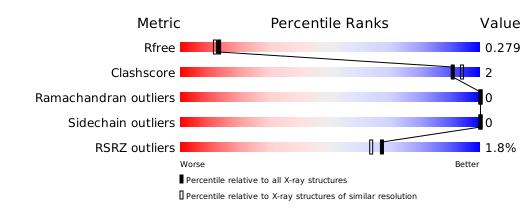
Structure validation
Download full validation report


