






 8ZXG
8ZXG
Crystal structure of Paraoxonase from Bacillus sp. strain S3wahi
Summary for 8ZXG
| Entry DOI | 10.2210/pdb8zxg/pdb |
| Descriptor | Paraoxonase from Bacillus sp. strain S3wahi, GLYCEROL, MAGNESIUM ION, ... (5 entities in total) |
| Functional Keywords | structural protein, hydrolase, metallo-b-lactamases, enzyme promiscuity, function, metallohydrolase, paraoxonase, ogranophosphate-degrading enzyme |
| Biological source | Bacillus sp. (in: firmicutes) |
| Total number of polymer chains | 1 |
| Total formula weight | 38033.29 |
| Authors | Azman, A.A.,Muhd Noor, N.D.,Leow, A.T.C.,Mohd Noor, S.A.,Mohamad Ali, M.S. (deposition date: 2024-06-14, release date: 2025-06-18, Last modification date: 2026-01-28) |
| Primary citation | Azman, A.A.,Basri, R.S.,Omar, M.N.,Noor, N.D.M.,Leow, A.T.C.,Latip, W.,Yamashita, E.,Nakagawa, A.,Ali, M.S.M. A microbial paraoxonase reveals structural principles of enzyme promiscuity in pollutant degradation. Int.J.Biol.Macromol., 339:149719-149719, 2025 Cited by PubMed Abstract: The widespread use of pesticides and antibiotics in agriculture has created environments contaminated by both organophosphates (OPs) and antibiotics compounds, posing significant ecological and public health challenges. Enzymes capable of degrading chemically diverse pollutants could provide versatile bioremediation solutions, yet the structural principles underlying such catalytic promiscuity remain poorly understood. In this study, the crystal structure and mechanistic insight of S3wahi-PON, a bacterial paraoxonase belonging to the metallo-β-lactamase superfamily, has been reported. S3wahi-PON is an organophosphorus hydrolase (OPH) that primarily functions as a paraoxonase, with previous kinetic analyses demonstrating its ability to act on diverse properties of substrates such as OP and antibiotic compounds. S3wahi-PON was crystallised using vapour diffusion and its structure was determined to reveal key features underlying its function. Structural analysis of S3wahi-PON at 1.49 Å resolution revealed an unusually flexible binuclear metal centre and a versatile binding pocket that enable the recognition of substrates with distinct physicochemical properties. Moreover, a dynamic surface loop remodels the active site to generate micro-binding pockets for different substrates, with shared residues contributing to the initial recognition of both paraoxon and ampicillin. By integrating structural and functional data with kinetic studies, molecular dynamics (MD) simulations, and normal mode analysis, a catalytic mechanism for paraoxon hydrolysis by S3wahi-PON has been proposed which highlights how conformational plasticity underpins enzymatic promiscuity. These findings demonstrate how a single enzyme architecture can accommodate diverse environmental toxins, offering new insights into the evolution of catalytic versatility and strategies for bioremediation. PubMed: 41435961DOI: 10.1016/j.ijbiomac.2025.149719 PDB entries with the same primary citation |
| Experimental method | X-RAY DIFFRACTION (1.494 Å) |
Structure validation
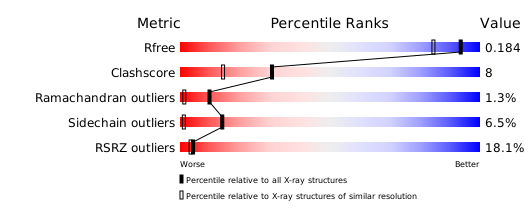
Download full validation report


