






 8ZU4
8ZU4
Crystal Structure of Methyl parathion hydrolase mutant A127L/I145L/Q272D/S279A/S304P
Summary for 8ZU4
| Entry DOI | 10.2210/pdb8zu4/pdb |
| Descriptor | Methyl parathion hydrolase, ZINC ION (3 entities in total) |
| Functional Keywords | hydrolase |
| Biological source | Pseudomonas sp. WBC-3 |
| Total number of polymer chains | 2 |
| Total formula weight | 63028.79 |
| Authors | |
| Primary citation | Li, Y.,Fu, Y.,Chen, X.,Fan, S.,Cao, Z.,Xu, F. A Dual-Focus Workflow for Simultaneously Engineering High Activity and Thermal Stability in Methyl Parathion Hydrolase. Angew.Chem.Int.Ed.Engl., 63:e202410881-e202410881, 2024 Cited by PubMed Abstract: Industrial fermentation applications typically require enzymes that exhibit high stability and activity at high temperatures. However, efforts to simultaneously improve these properties are usually limited by a trade-off between stability and activity. This report describes a computational strategy to enhance both activity and thermal stability of the mesophilic organophosphate-degrading enzyme, methyl parathion hydrolase (MPH). To predict hotspot mutation sites, we assembled a library of features associated with the target properties for each residue and then prioritized candidate sites by hierarchical clustering. Subsequent in silico screening with multiple algorithms to simulate selective pressures yielded a subset of 23 candidate mutations. Iterative parallel screening of mutations that improved thermal stability and activity yielded, MPHase-m5b, which exhibited 13.3 °C higher T and 4.2 times higher catalytic activity than wild-type (WT) MPH over a wide temperature range. Systematic analysis of crystal structures, molecular dynamics (MD) simulations, and quantum mechanics/molecular mechanics (QM/MM) calculations revealed a wider entrance to the active site that increased substrate access with an extensive network of interactions outside the active site that reinforced αβ/βα sandwich architecture to improve thermal stability. This study thus provides an advanced, rational design framework to improve efficiency in engineering highly active, thermostable biocatalysts for industrial applications. PubMed: 39126280DOI: 10.1002/anie.202410881 PDB entries with the same primary citation |
| Experimental method | X-RAY DIFFRACTION (1.39 Å) |
Structure validation
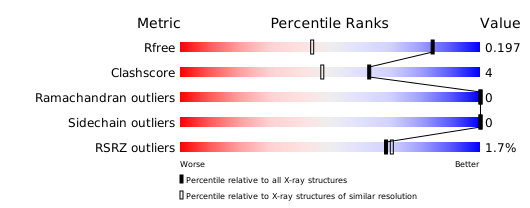
Download full validation report


