






 8ZRU
8ZRU
Structure of human ECHS1 in apo state
Summary for 8ZRU
| Entry DOI | 10.2210/pdb8zru/pdb |
| EMDB information | 60405 |
| Descriptor | Enoyl-CoA hydratase, mitochondrial, MAGNESIUM ION (2 entities in total) |
| Functional Keywords | echs1, hydrolase |
| Biological source | Homo sapiens (human) |
| Total number of polymer chains | 6 |
| Total formula weight | 170302.21 |
| Authors | |
| Primary citation | Su, G.,Xu, Y.,Chen, B.,Ju, K.,Jin, Y.,Chen, H.,Zhang, S.,Luan, X. Structural and biochemical mechanism of short-chain enoyl-CoA hydratase (ECHS1) substrate recognition. Commun Biol, 8:619-619, 2025 Cited by PubMed Abstract: Deficiency of short-chain enoyl-CoA hydratase (ECHS1), a crucial enzyme in fatty acid metabolism through the mitochondrial β-oxidation pathway, has been strongly linked to various diseases, especially cardiomyopathy. However, the structural and biochemical mechanisms through which ECHS1 recognizes acyl-CoAs remain poorly understood. Herein, cryo-EM analysis reveals the apo structure of ECHS1 and structures of the ECHS1-crotonyl-CoA, ECHS1-acetoacetyl-CoA, ECHS1-hexanoyl-CoA, and ECHS1-octanoyl-CoA complexes at high resolutions. The mechanism through which ECHS1 recognizes its substrates varies with the fatty acid chain lengths of acyl-CoAs. Furthermore, crucial point mutations in ECHS1 have a great impact on substrate recognition, resulting in significant changes in binding affinity and enzyme activity, as do disease-related point mutations in ECHS1. The functional mechanism of ECHS1 is systematically elucidated from structural and biochemical perspectives. These findings provide a theoretical basis for subsequent work focused on determining the role of ECHS1 deficiency (ECHS1D) in the occurrence of diseases such as cardiomyopathy. PubMed: 40240482DOI: 10.1038/s42003-025-07924-0 PDB entries with the same primary citation |
| Experimental method | ELECTRON MICROSCOPY (2.18 Å) |
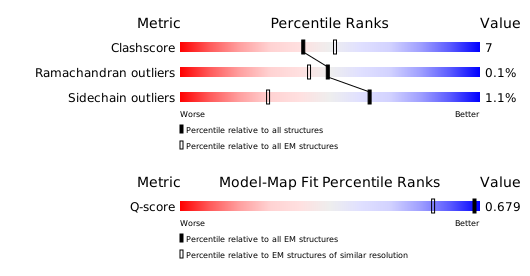
Structure validation
Download full validation report


