






 8Z3Y
8Z3Y
Cryo-EM structure of of hGPR4-Gs complex in pH6.8
Summary for 8Z3Y
| Entry DOI | 10.2210/pdb8z3y/pdb |
| EMDB information | 39757 |
| Descriptor | Guanine nucleotide-binding protein G(s) subunit alpha isoforms short, Guanine nucleotide-binding protein G(I)/G(S)/G(T) subunit beta-1, Guanine nucleotide-binding protein G(I)/G(S)/G(O) subunit gamma-2, ... (5 entities in total) |
| Functional Keywords | ph6.8, hgpr4, membrane protein, membrane protein-immune system complex, membrane protein/immune system |
| Biological source | Homo sapiens (human) More |
| Total number of polymer chains | 5 |
| Total formula weight | 160829.48 |
| Authors | Zhong, Y.N.,Guo, L.L. (deposition date: 2024-04-16, release date: 2025-06-04, Last modification date: 2026-06-17) |
| Primary citation | Guo, L.,Zhu, K.,Zhong, Y.N.,Gao, M.,Liu, J.,Qi, Z.,Liu, Z.,Rong, N.,Zhang, M.,Li, D.,Zhang, Q.,Yang, G.,Zhang, X.,Zhang, M.,Ding, N.,Ping, Y.Q.,Yang, Z.,Xiao, P.,Xia, M.,Yu, X.,Gaole, A.,Sun, J.P.,Yang, F. Structural basis and biased signaling of proton sensation by GPCRs mediated by extracellular histidine rearrangement. Mol.Cell, 85:1658-1673.e7, 2025 Cited by PubMed Abstract: Proton sensing by G protein-coupled receptors (GPCRs) is crucial in many life activities. However, its underlying mechanism remains unclear. Here, we report 8 cryoelectron microscopy (cryo-EM) structures of human GPR4 and GPR68 at different pH values and in complex with Gs or Gq trimers or in apo state. Structural inspection, structure-based pKa calculations, and mutational and computational analyses revealed that protonation of two conserved extracellular histidines induced polar network formation and other conformational changes to tether 7-transmembrane (TM7) to second extracellular loop (ECL2), and these changes constitute the central mechanisms of proton-induced activation of GPR4 and GPR68. Unexpectedly, proton sensation by specific extracellular histidine determined biased G protein coupling of GPR4. Moreover, GPR68's additional pH-sensing H84 enhances its function in a more acidic optimal pH range. The propagation path connecting proton-sensing histidines to the toggle switch was characterized. Collectively, we provide structural insights into the proton sensing, activation, and downstream effector coupling mechanisms of proton-sensing GPCRs. PubMed: 40215959DOI: 10.1016/j.molcel.2025.03.018 PDB entries with the same primary citation |
| Experimental method | ELECTRON MICROSCOPY (3.2 Å) |
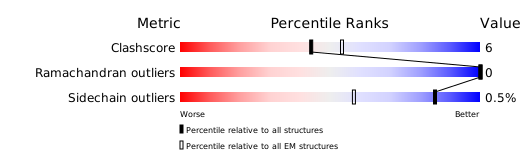
Structure validation
Download full validation report


