






 8YW9
8YW9
Cryo-EM structure of human mitochondrial pyruvate carrier in the matrix-facing conformation at pH 6.8
Summary for 8YW9
| Entry DOI | 10.2210/pdb8yw9/pdb |
| EMDB information | 39626 |
| Descriptor | Mitochondrial pyruvate carrier 2, Mitochondrial pyruvate carrier 1, MPC specific nanobody 2, ... (5 entities in total) |
| Functional Keywords | mitochondrial pyruvate carrier, mpc, pyruvate transport, protein transport |
| Biological source | Homo sapiens (human) More |
| Total number of polymer chains | 4 |
| Total formula weight | 61689.05 |
| Authors | Shi, J.H.,Liang, J.M.,Ma, D. (deposition date: 2024-03-30, release date: 2025-03-12, Last modification date: 2025-05-14) |
| Primary citation | Liang, J.,Shi, J.,Song, A.,Lu, M.,Zhang, K.,Xu, M.,Huang, G.,Lu, P.,Wu, X.,Ma, D. Structures and mechanism of the human mitochondrial pyruvate carrier. Nature, 641:258-265, 2025 Cited by PubMed Abstract: The mitochondrial pyruvate carrier (MPC) is a mitochondrial inner membrane protein complex that is essential for the uptake of pyruvate into the mitochondrial matrix as the primary carbon source for the tricarboxylic acid cycle. Here we present six cryo-electron microscopy structures of human MPC in three states: three structures in the intermembrane space (IMS)-open state, obtained in different conditions; a structure of pyruvate-treated MPC in the occluded state; and two structures in the matrix-facing state, bound with the inhibitor UK5099 or with an inhibitory nanobody on the matrix side. MPC is a heterodimer consisting of MPC1 and MPC2, with the transmembrane domain adopting pseudo-C2 symmetry. Approximate rigid-body movements occur between the IMS-open state and the occluded state, whereas structural changes, mainly on the matrix side, facilitate the transition between the occluded state and the matrix-facing state, revealing an alternating access mechanism during pyruvate transport. In the UK5099-bound structure, the inhibitor fits well and interacts extensively with a pocket that opens to the matrix side. Our findings provide key insights into the mechanisms that underlie MPC-mediated substrate transport, and shed light on the recognition and inhibition of MPC by UK5099, which will facilitate the future development of drugs that target MPC. PubMed: 40101766DOI: 10.1038/s41586-025-08873-8 PDB entries with the same primary citation |
| Experimental method | ELECTRON MICROSCOPY (3.01 Å) |
Structure validation
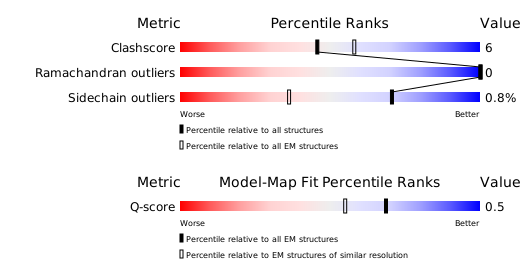
Download full validation report


