






 8YTK
8YTK
Crystal structure of human prolyl-tRNA synthetase in complex with inhibitor
Summary for 8YTK
| Entry DOI | 10.2210/pdb8ytk/pdb |
| Descriptor | Bifunctional glutamate/proline--tRNA ligase, (2~{S})-~{N}-[3-(4-azanylquinazolin-7-yl)phenyl]sulfonylpyrrolidine-2-carboxamide, 1,2-ETHANEDIOL, ... (4 entities in total) |
| Functional Keywords | prolyl-trna synthetase, inhibitor, complex, ligase |
| Biological source | Homo sapiens (human) |
| Total number of polymer chains | 2 |
| Total formula weight | 120169.18 |
| Authors | |
| Primary citation | Luo, Z.,Qiu, H.,Peng, X.,Tan, Q.,Chen, B.,Gu, Q.,Liu, H.,Zhou, H. Development of potent inhibitors targeting bacterial prolyl-tRNA synthetase through fluorine scanning-directed activity tuning. Eur.J.Med.Chem., 291:117647-117647, 2025 Cited by PubMed Abstract: As essential enzymes encoded by single genes, aminoacyl-tRNA synthetases (aaRSs) have long been considered promising drug targets for combating microbial infections. In this study, we developed a novel class of amino acid-ATP dual-site inhibitors of prolyl-tRNA synthetase (ProRS) through the structural simplification of the intermediate product prolyl adenylate and its non-hydrolyzable mimic. The co-crystal structures of the compound PAA-5 bound to both Pseudomonas aeruginosa and human cytoplasmic ProRSs (PaProRS and HsPrors) were solved to high resolution. Utilizing the structural information gained, a fluorine scanning (F-scanning) strategy was applied to PAA-5, and the biochemical and biophysical assays demonstrated that fluorine substitutions at specific positions of PAA-5 selectively enhanced its activity against bacterial ProRS. The dual-fluorinated derivative PAA-38 exhibited the highest antibacterial potency, with a K value of 0.399 ± 0.074 nM and an IC value of 4.97 ± 0.98 nM against PaProRS and an MIC value of 4-8 μg mL against tested bacterial strains. Our study provides a novel lead compound for the development of aaRS-based antibiotics and highlights F-scanning as a powerful strategy for lead optimization, particularly in pinpointing the subtle fluorophilic environments within the protein pocket to achieve better activity and selectivity. PubMed: 40253792DOI: 10.1016/j.ejmech.2025.117647 PDB entries with the same primary citation |
| Experimental method | X-RAY DIFFRACTION (2.553 Å) |
Structure validation
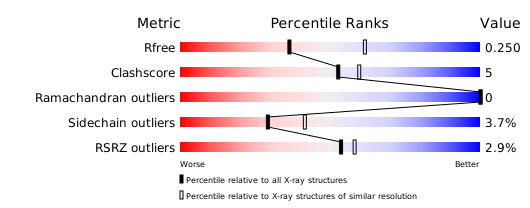
Download full validation report


