






 8YRM
8YRM
Iota toxin Ib pore serine-clamp mutant
Summary for 8YRM
| Entry DOI | 10.2210/pdb8yrm/pdb |
| EMDB information | 39544 |
| Descriptor | Iota toxin component Ib, CALCIUM ION (2 entities in total) |
| Functional Keywords | bacterial binary toxin, protein translocation channel, adp-ribosylation, toxin |
| Biological source | Clostridium perfringens |
| Total number of polymer chains | 7 |
| Total formula weight | 408254.30 |
| Authors | Ninomiya, Y.,Yoshida, T.,Yamada, T.,Kishikawa, J.,Tsuge, H. (deposition date: 2024-03-21, release date: 2025-03-26, Last modification date: 2025-08-13) |
| Primary citation | Yoshida, T.,Monma, C.,Ninomiya, Y.,Takiguchi, S.,Fujita, S.,Uchida, Y.,Sakoda, N.,Karginov, V.A.,Kishikawa, J.I.,Yamada, T.,Kawano, R.,Tsuge, H. Serine clamp of Clostridium perfringens binary toxin BECb (CPILEb)-pore confers cytotoxicity and enterotoxicity. Commun Biol, 8:1102-1102, 2025 Cited by PubMed Abstract: BEC (CPILE) is a virulence factor of the pathogen, Clostridium perfringens, which has caused foodborne outbreaks in Japan. BEC is a binary toxin that comprises the enzymatic A-component (BECa) and the B-component (BECb); the latter forms a membrane pore to translocate the A-component into target cells. Although BEC differs from other binary toxins in that the B-component alone shows enterotoxic activity, the reason for this remains unclear. We focus on the narrowest region of BECb-pore formed by not phenylalanine residues conserved in other binary toxins including iota toxin B-component (Ib) but serine residues. Comparisons between BECb and BECb (S405F) where the serine residue forming the narrowest region is substituted to the phenylalanine residue reveal that the serine residue is responsible for both cytotoxicity and enterotoxic activity. Though attempts to prepare the BECb-pore were unsuccessful, we reveal the cryo-EM structure of Ib (F454S) where the phenylalanine residue forming the narrowest region is substituted to the serine residue as a surrogate of BECb. Furthermore, Ib (F454S) increases current conductance to nine times that of Ib due to the larger pore diameter and the hydrophilic nature. These results suggest that BECb functions as a pore-forming toxin and as a translocation channel for BECa. PubMed: 40715636DOI: 10.1038/s42003-025-08519-5 PDB entries with the same primary citation |
| Experimental method | ELECTRON MICROSCOPY (2.36 Å) |
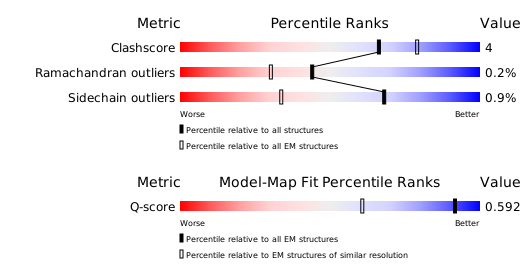
Structure validation
Download full validation report


