






 8YL7
8YL7Summary for 8YL7
| Entry DOI | 10.2210/pdb8yl7/pdb |
| EMDB information | 39384 |
| Descriptor | Protein EDS1, Senescence-associated carboxylesterase 101, Probable disease resistance protein At5g66890, ... (4 entities in total) |
| Functional Keywords | effector-triggered immunity (eti), enhanced disease susceptibility1, senescence-associated gene101, n required gene 1.3, immune system, immune system-hydrolase complex, immune system/hydrolase |
| Biological source | Arabidopsis thaliana (thale cress) More |
| Total number of polymer chains | 3 |
| Total formula weight | 182588.80 |
| Authors | Wu, X.X.,Xiao, Y.Y.,Wang, Z.Z.,Zhang, Y.,Wan, L. (deposition date: 2024-03-05, release date: 2025-01-29, Last modification date: 2025-03-26) |
| Primary citation | Xiao, Y.,Wu, X.,Wang, Z.,Ji, K.,Zhao, Y.,Zhang, Y.,Wan, L. Activation and inhibition mechanisms of a plant helper NLR. Nature, 639:438-446, 2025 Cited by PubMed Abstract: Plant nucleotide-binding leucine-rich repeat (NLR) receptors sense pathogen effectors and form resistosomes to confer immunity. Some sensor NLR resistosomes produce small molecules to induce formation of a heterotrimer complex with two lipase-like proteins, EDS1 and SAG101, and a helper NLR called NRG1 (refs. ). Activation of sensor NLR resistosomes also triggers NRG1 oligomerization and resistosome formation at the plasma membrane. We demonstrate that the Arabidopsis AtEDS1-AtSAG101-AtNRG1A heterotrimer formation is stabilized by the AtNRG1A loss-of-oligomerization mutant L134E. We report structures of AtEDS1-AtSAG101-AtNRG1A L134E and AtEDS1-AtSAG101-AtNRG1C heterotrimers with similar assembly mechanisms. AtNRG1A signalling is activated by the interaction with the AtEDS1-AtSAG101 heterodimer in complex with their small-molecule ligand. The truncated AtNRG1C maintains core interacting domains of AtNRG1A but develops further interactions with AtEDS1-AtSAG101 to outcompete AtNRG1A. Moreover, AtNRG1C lacks an N-terminal signalling domain and shows nucleocytoplasmic localization, facilitating its sequestration of AtEDS1-AtSAG101, which is also nucleocytoplasmic. Our study shows the activation and inhibition mechanisms of a plant helper NLR. PubMed: 39939758DOI: 10.1038/s41586-024-08517-3 PDB entries with the same primary citation |
| Experimental method | ELECTRON MICROSCOPY (3.1 Å) |
Structure validation
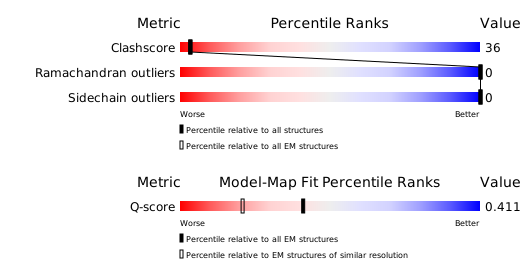
Download full validation report


