






 8YAA
8YAA
Cryo-EM structure of MIK2-SCOOP12-BAK1
Summary for 8YAA
| Entry DOI | 10.2210/pdb8yaa/pdb |
| EMDB information | 39093 |
| Descriptor | BRASSINOSTEROID INSENSITIVE 1-associated receptor kinase 1, MDIS1-interacting receptor like kinase 2, Serine rich endogenous peptide 12, ... (7 entities in total) |
| Functional Keywords | lrr-rlk, serk, mik2, scoop, bak1, plant protein, transferase, plant protein complex, transferase-plant protein complex, transferase/plant protein |
| Biological source | Arabidopsis thaliana (thale cress) More |
| Total number of polymer chains | 3 |
| Total formula weight | 99848.86 |
| Authors | Jia, F.S.,Xiao, Y.,Chai, J.J. (deposition date: 2024-02-08, release date: 2024-10-30, Last modification date: 2025-01-01) |
| Primary citation | Jia, F.,Xiao, Y.,Feng, Y.,Yan, J.,Fan, M.,Sun, Y.,Huang, S.,Li, W.,Zhao, T.,Han, Z.,Hou, S.,Chai, J. N-glycosylation facilitates the activation of a plant cell-surface receptor. Nat.Plants, 10:2014-2026, 2024 Cited by PubMed Abstract: Plant receptor kinases (RKs) are critical for transmembrane signalling involved in various biological processes including plant immunity. MALE DISCOVERER1-INTERACTING RECEPTOR-LIKE KINASE 2 (MIK2) is a unique RK that recognizes a family of immunomodulatory peptides called SERINE-RICH ENDOGENOUS PEPTIDEs (SCOOPs) and activates pattern-triggered immunity responses. However, the precise mechanisms underlying SCOOP recognition and activation of MIK2 remain poorly understood. Here we present the cryogenic electron microscopy structure of a ternary complex consisting of the extracellular leucine-rich repeat (LRR) of MIK2 (MIK2LRR), SCOOP12 and the extracellular LRR of the co-receptor BAK1 (BAK1LRR) at a resolution of 3.34 Å. The structure reveals that a DNHH motif in MIK2LRR plays a critical role in specifically recognizing the highly conserved SxS motif of SCOOP12. Furthermore, the structure demonstrates that N-glycans at MIK2LRR directly interact with the N-terminal capping region of BAK1LRR. Mutation of the glycosylation site, MIK2LRR, completely abolishes the SCOOP12-independent interaction between MIK2LRR and BAK1LRR and substantially impairs the assembly of the MIK2LRR-SCOOP12-BAK1LRR complex. Supporting the biological relevance of N410-glycosylation, MIK2 substantially compromises SCOOP12-triggered immune responses in plants. Collectively, these findings elucidate the mechanism underlying the loose specificity of SCOOP recognition by MIK2 and reveal an unprecedented mechanism by which N-glycosylation modification of LRR-RK promotes receptor activation. PubMed: 39511417DOI: 10.1038/s41477-024-01841-6 PDB entries with the same primary citation |
| Experimental method | ELECTRON MICROSCOPY (3.34 Å) |
Structure validation
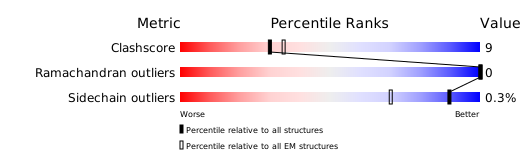
Download full validation report


