






 8Y55
8Y55Summary for 8Y55
| Entry DOI | 10.2210/pdb8y55/pdb |
| Descriptor | Nicotinamide phosphoribosyltransferase, (13~{a}~{S})-6,7-dimethoxy-9,11,12,13,13~{a},14-hexahydrophenanthro[9,10-f]indolizin-3-ol, DI(HYDROXYETHYL)ETHER, ... (4 entities in total) |
| Functional Keywords | nampt, biosynthetic protein |
| Biological source | Homo sapiens (human) |
| Total number of polymer chains | 2 |
| Total formula weight | 112313.20 |
| Authors | |
| Primary citation | Li, F.,Zhang, Z.,Shi, Q.,Wang, R.,Ji, M.,Chen, X.,Li, Y.,Liu, Y.,Yu, S. Thermal proteome profiling (TPP) reveals NAMPT as the anti-glioma target of phenanthroindolizidine alkaloid PF403. Acta Pharm Sin B, 15:2008-2023, 2025 Cited by PubMed Abstract: Glioma is difficult to treat due to the unique tumor microenvironment and blood-brain barrier. (13a)-3-Hydroxyl-6,7-dimethoxyphenanthro[9,10-] indolizidine (PF403), a phenanthroindolizidine alkaloid, has been identified as a promising therapeutic agent for the treatment of glioma. However, the anti-glioma mechanism of PF403 has not been conclusively verified and must be further elucidated. Hence, a strategy without chemical modification was applied to identify the target of PF403. In this study, we identified nicotinamide phosphoribosyl transferase (NAMPT) as the target of PF403 by using thermal proteome profiling (TPP). Moreover, microscale thermophoresis (MST), surface plasmon resonance (SPR), and isothermal titration calorimetry (ITC) experiments confirmed that NAMPT exhibits good affinity for PF403. Direct and indirect enzyme activity assays revealed that PF403 inhibited the catalytic activity of NAMPT, leading to a decrease in the concentration of nicotinamide adenine dinucleotide (NAD) in U87 cells. X-ray diffraction and amino acid spot mutation experiments revealed that PF403 primarily relies on the formation of pi-pi interactions with residue Tyr188 to maintain binding with NAMPT (PDB code 8Y55). After NAMPT was knocked down with lentivirus, PF403 lost or partially lost its antitumor activity at the cellular and animal levels. These findings suggest that PF403 exerts antitumor activity by directly targeting NAMPT. PubMed: 40486861DOI: 10.1016/j.apsb.2025.02.027 PDB entries with the same primary citation |
| Experimental method | X-RAY DIFFRACTION (1.86 Å) |
Structure validation
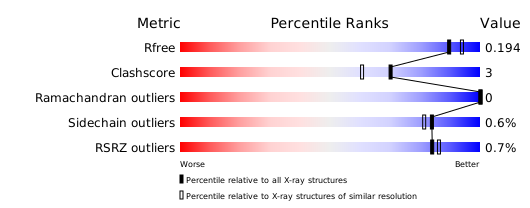
Download full validation report


