






 8XM4
8XM4
Methionyl-tRNA synthetase from Staphylococcus aureus in complex with chlorhexidine and ATP
Summary for 8XM4
| Entry DOI | 10.2210/pdb8xm4/pdb |
| Descriptor | Methionine--tRNA ligase, ADENOSINE-5'-TRIPHOSPHATE, 1-[6-[azanylidene-[[azanylidene-[[(4-chlorophenyl)amino]methyl]-$l^{4}-azanyl]methyl]-$l^{4}-azanyl]hexyl]-3-[~{N}-(4-chlorophenyl)carbamimidoyl]guanidine, ... (5 entities in total) |
| Functional Keywords | metrs, methionyl-trna synthetase, ligase |
| Biological source | Staphylococcus aureus subsp. aureus COL |
| Total number of polymer chains | 1 |
| Total formula weight | 62364.87 |
| Authors | |
| Primary citation | Lu, F.,Xia, K.,Su, J.,Yi, J.,Luo, Z.,Xu, J.,Gu, Q.,Chen, B.,Zhou, H. Biochemical and structural characterization of chlorhexidine as an ATP-assisted inhibitor against type 1 methionyl-tRNA synthetase from Gram-positive bacteria. Eur.J.Med.Chem., 268:116303-116303, 2024 Cited by PubMed Abstract: Methionyl-tRNA synthetase (MetRS) catalyzes the attachment of l-methionine (l-Met) to tRNA to generate methionyl-tRNA, an essential substrate for protein translation within ribosome. Owing to its indispensable biological function and the structural discrepancies with human counterpart, bacterial MetRS is considered an ideal target for developing antibacterials. Herein, chlorhexidine (CHX) was identified as a potent binder of Staphylococcus aureus MetRS (SaMetRS) through an ATP-aided affinity screening. The co-crystal structure showed that CHX simultaneously occupies the enlarged l-Met pocket (EMP) and the auxiliary pocket (AP) of SaMetRS with its two chlorophenyl groups, while its central hexyl linker swings upwards to interact with some conserved hydrophobic residues. ATP adopts alternative conformations in the active site cavity, and forms ionic bonds and water-mediated hydrogen bonds with CHX. Consistent with this synergistic binding mode, ATP concentration-dependently enhanced the binding affinity of CHX to SaMetRS from 10.2 μM (no ATP) to 0.45 μM (1 mM ATP). While it selectively inhibited two representative type 1 MetRSs from S. aureus and Enterococcus faecalis, CHX did not show significant interactions with three tested type 2 MetRSs, including human cytoplasmic MetRS, in the enzyme inhibition and biophysical binding assays, probably due to the conformational differences between two types of MetRSs at their EMP and AP. Our findings on CHX may inspire the design of MetRS-directed antimicrobials in future. PubMed: 38458107DOI: 10.1016/j.ejmech.2024.116303 PDB entries with the same primary citation |
| Experimental method | X-RAY DIFFRACTION (1.67 Å) |
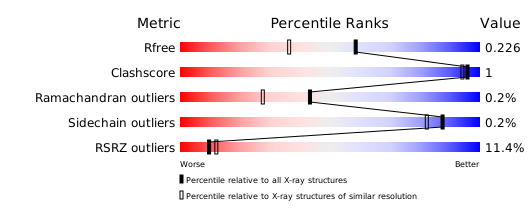
Structure validation
Download full validation report


