






 8XG9
8XG9
Crystal structure of phenylacetone monooxygenase mutant PM3 bound to FAD and NADP
Summary for 8XG9
| Entry DOI | 10.2210/pdb8xg9/pdb |
| Descriptor | Phenylacetone monooxygenase, FLAVIN-ADENINE DINUCLEOTIDE, NADP NICOTINAMIDE-ADENINE-DINUCLEOTIDE PHOSPHATE, ... (7 entities in total) |
| Functional Keywords | phenylacetone monooxygenase, fad-binding, nadph-binding, monomer, oxidoreductase |
| Biological source | Thermobifida fusca YX |
| Total number of polymer chains | 1 |
| Total formula weight | 63710.51 |
| Authors | |
| Primary citation | Li, X.,Li, C.,Qu, G.,Yuan, B.,Sun, Z. Engineering of a Baeyer-Villiger monooxygenase to Improve Substrate Scope, Stereoselectivity and Regioselectivity. Chembiochem, 25:e202400328-e202400328, 2024 Cited by PubMed Abstract: Baeyer-Villiger monooxygenases belong to a family of flavin-binding proteins that catalyze the Baeyer-Villiger (BV) oxidation of ketones to produce lactones or esters, which are important intermediates in pharmaceuticals or sustainable materials. Phenylacetone monooxygenase (PAMO) from Thermobifida fusca with moderate thermostability catalyzes the oxidation of aryl ketone substrates, but is limited by high specificity and narrow substrate scope. In the present study, we applied loop optimization by loop swapping followed by focused saturation mutagenesis in order to evolve PAMO mutants capable of catalyzing the regioselective BV oxidation of cyclohexanone and cyclobutanone derivatives with formation of either normal or abnormal esters or lactones. We further modulated PAMO to increase enantioselectivity. Crystal structure studies indicate that rotation occurs in the NADP-binding domain and that the high B-factor region is predominantly distributed in the catalytic pocket residues. Computational analyses further revealed dynamic character in the catalytic pocket and reshaped hydrogen bond interaction networks, which is more favorable for substrate binding. Our study provides useful insights for studying enzyme-substrate adaptations. PubMed: 38742991DOI: 10.1002/cbic.202400328 PDB entries with the same primary citation |
| Experimental method | X-RAY DIFFRACTION (2 Å) |
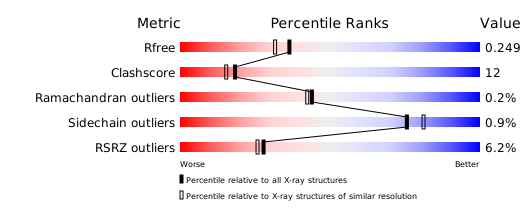
Structure validation
Download full validation report


