






 8X65
8X65
Crystal structure of X11P(P71T) xylanase from a metagenome derived gene from sugarcane bagasse collection site
Summary for 8X65
| Entry DOI | 10.2210/pdb8x65/pdb |
| Descriptor | Endo-1,4-beta-xylanase (2 entities in total) |
| Functional Keywords | gh11 xylanase, hydrolase |
| Biological source | uncultured bacterium |
| Total number of polymer chains | 1 |
| Total formula weight | 22910.81 |
| Authors | Chitnumsub, P.,Jaruwat, A.,Boonyapakron, K.,Prabmark, K. (deposition date: 2023-11-20, release date: 2024-11-27, Last modification date: 2024-12-25) |
| Primary citation | Boonyapakron, K.,Keiser, B.,Prabmark, K.,Aiewviriyasakul, K.,Arunrattanamook, N.,Jaruwat, A.,Chitnumsub, P.,Li, J.Y.,Wong, T.S.,Zhao, X.Q.,Liu, C.G.,Wei, D.Q.,Champreda, V. Hyperthermophilic xylanase and thermophilicity analysis by molecular dynamic simulation with quantum mechanics. Appl.Microbiol.Biotechnol., 108:526-526, 2024 Cited by PubMed Abstract: Thermophilic xylanases catalyzing the cleavage of β-1,4-glycosidic bonds in xylan have applications in food, feed, biorefinery, and pulp industries. In this study, a hyperthermophilic endo-xylanase was obtained by further enhancement of thermal tolerance of a thermophilic GH11 xylanase originated from metagenome of bagasse pile based on rational design. Introducing N13F and Q34L to the previously reported X11P enzyme shifted the optimal working temperature to 85 °C and led to 20.7-fold improvement in thermostability at 90 °C along with a marked increase in T to 93.3 °C. X11PNQ enzyme converted xylan to prebiotic xylooligosaccharides with high specificity on xylobiose to xylohexaose and high operational stability at 85 °C, resulting in 10.3-folds yield improvement compared to the parental enzyme. Molecular dynamic simulation and quantum mechanical analysis revealed improved H-bonding networks within GH11 xylanase principal domains and greater dynamic cross-correlations. A novel thermostabilization mechanism by π-amide interaction with slightly lower interaction energy than the native H-bond, but compensated by increased occurrence frequency was firstly demonstrated for thermophilic enzymes. The enzyme represents one of the most thermostable xylanases ever reported with biotechnological potential. KEY POINTS: • Hyperthemophilic xylanase X11PNQ was obtained by rational design engineering. • X11PNQ showed specificity to prebiotic xylooligosaccharides (XOS) at 85 °C with improved t at 90 °C. • Novel thermostabilization by π-amide interaction was demonstrated by MD/QM. PubMed: 39630239DOI: 10.1007/s00253-024-13356-3 PDB entries with the same primary citation |
| Experimental method | X-RAY DIFFRACTION (1.7 Å) |
Structure validation
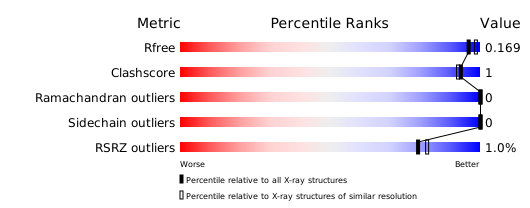
Download full validation report


