






8X1B
Cryo-EM structure of FpGalactosaminidase from Flavonifractor plautii in apo state
Summary for 8X1B
| Entry DOI | 10.2210/pdb8x1b/pdb |
| EMDB information | 37989 |
| Descriptor | Alpha-galactosidase (1 entity in total) |
| Functional Keywords | flavonifractor plautii, a to o type blood, d-(+)-galactosamine hydrochloride, hydrolase |
| Biological source | Flavonifractor plautii |
| Total number of polymer chains | 1 |
| Total formula weight | 72515.05 |
| Authors | |
| Primary citation | Zhou, M.,Luo, K.,Su, C.,Sun, Y.,Huang, Z.,Ma, S.,Gao, X.,Wang, J.,Zhang, C.,Han, P.,Wu, G. Structural basis of FpGalNase and its combination with FpGalNAcDeAc for efficient A-to-O blood group conversion. Exp Hematol Oncol, 14:7-7, 2025 Cited by PubMed Abstract: Transfusion safety and blood typing continue to present significant challenges in clinical practice, including risks of incorrect blood transfusions and blood shortages. One promising solution is the enzymatic conversion of all red blood cell (RBC) types into universal O-type RBCs. However, the major obstacle to this strategy is the relatively low catalytic efficiency of the enzymes involved. In this study, we investigated two enzymes from Flavonifractor plautii, N-acetylgalactosamine deacetylase (FpGalNAcDeAc) and galactosaminidase (FpGalNase), which demonstrate synergistic activity in efficiently converting A-type RBCs to O-type. We optimized treatment conditions, achieving over 99% conversion in just five minutes using phosphate buffer saline and a 16 nM enzyme concentration. Additionally, we engineered two fusion proteins, FpGalNAcDeAc-FpGalNase and FpGalNase-FpGalNAcDeAc, which showed a 28-fold increase in catalytic efficiency compared to the enzyme mixture. Using cryo-electron microscopy, we resolved the full-length structure of FpGalNase, identifying critical active site residues involved in its catalytic mechanism. This study provides essential structural and biochemical insights for clinical applications in blood group conversion, offering a promising approach for producing universal O-type RBCs. PubMed: 39856738DOI: 10.1186/s40164-025-00599-7 PDB entries with the same primary citation |
| Experimental method | ELECTRON MICROSCOPY (2.59 Å) |
Structure validation
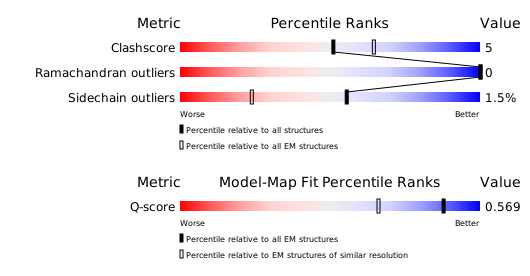
Download full validation report


