






 8WCM
8WCM
NSs filament formation determines RVFV pathogenesis
Summary for 8WCM
| Entry DOI | 10.2210/pdb8wcm/pdb |
| EMDB information | 37443 |
| Descriptor | Non-structural protein NS-S (1 entity in total) |
| Functional Keywords | self-assembly, helical structure, viral protein |
| Biological source | Rift Valley fever virus |
| Total number of polymer chains | 2 |
| Total formula weight | 61740.44 |
| Authors | |
| Primary citation | Li, H.,Zhang, Y.,Rao, G.,Zhang, C.,Guan, Z.,Huang, Z.,Li, S.,Lozach, P.Y.,Cao, S.,Peng, K. Rift Valley fever virus coordinates the assembly of a programmable E3 ligase to promote viral replication. Cell, 187:6896-, 2024 Cited by PubMed Abstract: Viruses encode strategies to degrade cellular proteins to promote infection and pathogenesis. Here, we revealed that the non-structural protein NSs of Rift Valley fever virus forms a filamentous E3 ligase to trigger efficient degradation of targeted proteins. Reconstitution in vitro and cryoelectron microscopy analysis with the 2.9-Å resolution revealed that NSs forms right-handed helical fibrils. The NSs filamentous oligomers associate with the cellular FBXO3 to form a remodeled E3 ligase. The NSs-FBXO3 E3 ligase targets the cellular TFIIH complex through the NSs-P62 interaction, leading to ubiquitination and proteasome-dependent degradation of the TFIIH complex. NSs-FBXO3-triggered TFIIH complex degradation resulted in robust inhibition of antiviral immunity and promoted viral pathogenesis in vivo. Furthermore, it is demonstrated that NSs can be programmed to target additional proteins for proteasome-dependent degradation, serving as a versatile targeted protein degrader. These results showed that a virulence factor forms a filamentous and programmable degradation machinery to induce organized degradation of cellular proteins to promote viral infection. PubMed: 39366381DOI: 10.1016/j.cell.2024.09.008 PDB entries with the same primary citation |
| Experimental method | ELECTRON MICROSCOPY (2.94 Å) |
Structure validation
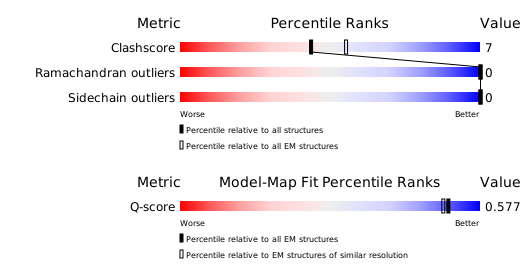
Download full validation report


