






 8W4A
8W4A
membrane proteins
Summary for 8W4A
| Entry DOI | 10.2210/pdb8w4a/pdb |
| EMDB information | 37264 |
| Descriptor | Heparan-alpha-glucosaminide N-acetyltransferase, DODECANE, HEPTANE, ... (12 entities in total) |
| Functional Keywords | enzyme, acetylation, membrane protein |
| Biological source | Homo sapiens (human) |
| Total number of polymer chains | 2 |
| Total formula weight | 170817.05 |
| Authors | |
| Primary citation | Xu, R.,Ning, Y.,Ren, F.,Gu, C.,Zhu, Z.,Pan, X.,Pshezhetsky, A.V.,Ge, J.,Yu, J. Structure and mechanism of lysosome transmembrane acetylation by HGSNAT. Nat.Struct.Mol.Biol., 31:1502-1508, 2024 Cited by PubMed Abstract: Lysosomal transmembrane acetylation of heparan sulfates (HS) is catalyzed by HS acetyl-CoA:α-glucosaminide N-acetyltransferase (HGSNAT), whose dysfunction leads to lysosomal storage diseases. The mechanism by which HGSNAT, the sole non-hydrolase enzyme in HS degradation, brings cytosolic acetyl-coenzyme A (Ac-CoA) and lysosomal HS together for N-acyltransferase reactions remains unclear. Here, we present cryogenic-electron microscopy structures of HGSNAT alone, complexed with Ac-CoA and with acetylated products. These structures explain that Ac-CoA binding from the cytosolic side causes dimeric HGSNAT to form a transmembrane tunnel. Within this tunnel, catalytic histidine and asparagine approach the lumen and instigate the transfer of the acetyl group from Ac-CoA to the glucosamine group of HS. Our study unveils a transmembrane acetylation mechanism that may help advance therapeutic strategies targeting lysosomal storage diseases. PubMed: 38769387DOI: 10.1038/s41594-024-01315-5 PDB entries with the same primary citation |
| Experimental method | ELECTRON MICROSCOPY (2.69 Å) |
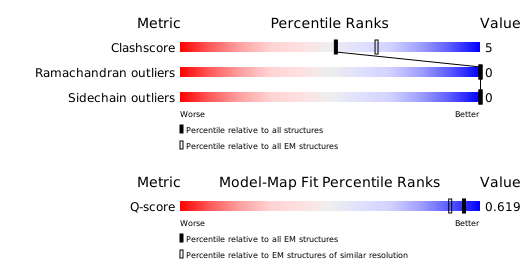
Structure validation
Download full validation report


