






 8W23
8W23
Cryo-EM structure of human tankyrase 2 SAM-PARP filament bound to compound, TDI-2804 (consensus map).
This is a non-PDB format compatible entry.
Summary for 8W23
| Entry DOI | 10.2210/pdb8w23/pdb |
| EMDB information | 43738 43740 43741 43758 43759 |
| Descriptor | Maltose/maltodextrin-binding periplasmic protein,Poly [ADP-ribose] polymerase tankyrase-2, ZINC ION, N-{2-[4-(2-hydroxypropan-2-yl)phenyl]-4-oxo-1,4-dihydroquinazolin-7-yl}-4-methoxy-6-phenylpyridine-3-carboxamide (3 entities in total) |
| Functional Keywords | nad+ adp-ribosyltransferase, wnt signaling, inhibitor, signaling protein, signaling protein-inhibitor complex, signaling protein/inhibitor |
| Biological source | Homo sapiens (human) More |
| Total number of polymer chains | 20 |
| Total formula weight | 1623719.38 |
| Authors | Malone, B.F.,Zimmerman, J.L.,Dow, L.E.,Hite, R.K. (deposition date: 2024-02-19, release date: 2025-07-09) |
| Primary citation | Zimmerman, J.,Malone, B.F.,Finkin-Groner, E.,Sun, S.,Liang, R.,Foronda, M.,Schatoff, E.M.,Granowsky, E.,Goswami, S.,Katti, A.,Leach, B.,Alcorn, H.,Tammela, T.,Fukase, Y.,Khan, T.,Huggins, D.J.,Ginn, J.,Liverton, N.,Hite, R.K.,Dow, L.E. A potent and selective TNKS2 inhibitor for tumor-selective WNT suppression. Biorxiv, 2025 Cited by PubMed Abstract: Hyperactive WNT signaling is a potent cancer driver, but clinical translation of WNT inhibitors has been hampered by on-target toxicities. WNT signaling can be constrained through inhibition of the PARP family enzymes Tankyrase 1 (TNKS1) and Tankyrase 2 (TNKS2), however, existing TNKS inhibitors suppress WNT signaling in both tumor and healthy tissues. In this study, we show that the loss of chromosome 8p that occurs in approximately half of advanced epithelial malignancies, creates a collateral vulnerability that enables tumor-selective inhibition of Tankyrase activity. 8p loss depletes expression of TNKS1 and creates a tumor-specific dependency on the functionally redundant TNKS2 protein. Through structure-guided drug design, we identify a first-in-class TNKS2-selective inhibitor that can drive selective WNT inhibition in TNKS1-deficient oncogenic cell and organoid models. This work demonstrates a targetable vulnerability in multiple cancer types, providing a new approach to potent and selective WNT-targeted therapies. PubMed: 40093088DOI: 10.1101/2025.03.04.641305 PDB entries with the same primary citation |
| Experimental method | ELECTRON MICROSCOPY (2.28 Å) |
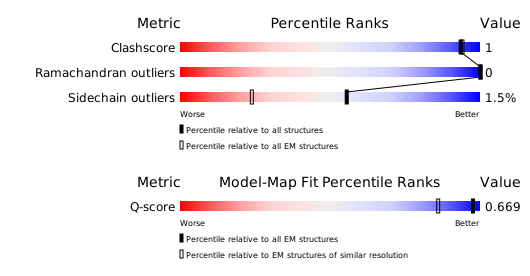
Structure validation
Download full validation report


