






 8VYJ
8VYJ
Structure of full-length human cardiac sodium channel - Class-I.
Summary for 8VYJ
| Entry DOI | 10.2210/pdb8vyj/pdb |
| EMDB information | 43662 |
| Descriptor | Sodium channel protein type 5 subunit alpha, 2-acetamido-2-deoxy-beta-D-glucopyranose-(1-4)-2-acetamido-2-deoxy-beta-D-glucopyranose-(1-4)-2-acetamido-2-deoxy-beta-D-glucopyranose-(1-4)-2-acetamido-2-deoxy-beta-D-glucopyranose-(1-4)-2-acetamido-2-deoxy-beta-D-glucopyranose, 2-acetamido-2-deoxy-beta-D-glucopyranose-(1-4)-2-acetamido-2-deoxy-beta-D-glucopyranose, ... (6 entities in total) |
| Functional Keywords | voltage gated sodium channel, nav1.5, ion transporter, membrane protein |
| Biological source | Homo sapiens (human) |
| Total number of polymer chains | 1 |
| Total formula weight | 234966.04 |
| Authors | Biswas, R.,Chinthalapudi, K. (deposition date: 2024-02-08, release date: 2025-02-12, Last modification date: 2026-02-25) |
| Primary citation | Biswas, R.,Lopez-Serrano, A.L.,Purohit, A.,Ramirez-Navarro, A.,Huang, H.L.,Grandinetti, G.,Cheng, X.,Heissler, S.M.,Deschenes, I.,Chinthalapudi, K. Structural basis of human Na v 1.5 gating mechanisms. Proc.Natl.Acad.Sci.USA, 122:e2416181122-e2416181122, 2025 Cited by PubMed Abstract: Voltage-gated Na1.5 channels are central to the generation and propagation of cardiac action potentials. Aberrations in their function are associated with a wide spectrum of cardiac diseases including arrhythmias and heart failure. Despite decades of progress in Na1.5 biology, the lack of structural insights into intracellular regions has hampered our understanding of its gating mechanisms. Here, we present two cryo-EM structures of human Na1.5 in open states, revealing sequential conformational changes in gating charges of the voltage-sensing domains (VSDs) and several intracellular regions. Despite the channel being in the open state, these structures show repositioning, but no dislodging of the IFM motif in the receptor site. Molecular dynamics analyses show our structures with CTD conduct Na ions. Notably, our structural findings highlight a dynamic C-terminal domain (CTD) and III-IV linker interaction, which regulates the conformation of VSDs and pore opening. Electrophysiological studies confirm that disrupting this interaction alters fast inactivation of Na1.5. Together, our structure-function studies establish a foundation for understanding the gating mechanisms of Na1.5 and the mechanisms underlying CTD-related channelopathies. PubMed: 40366698DOI: 10.1073/pnas.2416181122 PDB entries with the same primary citation |
| Experimental method | ELECTRON MICROSCOPY (3.6 Å) |
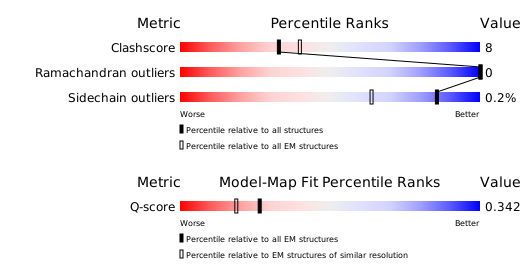
Structure validation
Download full validation report


