






 8VUK
8VUK
The crystal structure of Brucella abortus FtrB at 1.3 Angstrom resolution
Summary for 8VUK
| Entry DOI | 10.2210/pdb8vuk/pdb |
| Descriptor | EfeO-type cupredoxin-like domain-containing protein, MANGANESE (II) ION (3 entities in total) |
| Functional Keywords | brucella abortus, iron transport, ftrabcd, metal binding protein |
| Biological source | Brucella abortus |
| Total number of polymer chains | 1 |
| Total formula weight | 10314.45 |
| Authors | Roy, S.,Garcia, B.L. (deposition date: 2024-01-29, release date: 2025-01-22, Last modification date: 2025-08-06) |
| Primary citation | Kerkan, A.,Hart, K.,Martin, D.W.,Pajski, J.,Aidoo, B.,Garcia, B.L.,Roy, S.,Dasgupta, S.,Hematian, S.,Santisteban-Veiga, A.,Schaaf, N.J.,Banerjee, S. In Vitro Structural and Functional Studies of a Novel Cupredoxin, FtrB, from Brucella abortus 2308. Acs Omega, 10:12653-12670, 2025 Cited by PubMed Abstract: FtrABCD is a four-component iron transporter found in several Gram-negative bacteria. Previous data confirm that FtrABCD can only utilize Fe and the inner membrane permease, FtrC, from this system, like its eukaryotic homologue, Ftr1p, is predicted to utilize the free energy released during Fe oxidation for the transport. Periplasmic FtrB from this system is coancestral with known copper oxidases, and the conserved D118 and H121 are predicted to bind to Cu, forming an active enzyme. In this work, we report structural data for recombinant wild-type and D118A and H121A mutants from 2308 which confirm a β-sheet-rich structure which is distinct from known cupredoxins. Calorimetric studies on the wild-type protein show μM affinities for Cu and an Fe mimic (Mn), which facilitate the formation of the active enzyme and the enzyme-substrate complex, respectively. In contrast, the D118A mutant failed to bind Cu. Finally, the electrochemical data reported here revealed biologically accessible reduction potentials for the Cu ion in the active enzyme which also showed a pseudozero-order rate of Fe oxidation at pH 6.5 and could oxidize Fe 3.5-times faster than its rate of autoxidation. Taken together, this report provides experimental data that support structural and functional predictions of FtrB under in vitro conditions. PubMed: 40191301DOI: 10.1021/acsomega.5c00690 PDB entries with the same primary citation |
| Experimental method | X-RAY DIFFRACTION (1.3 Å) |
Structure validation
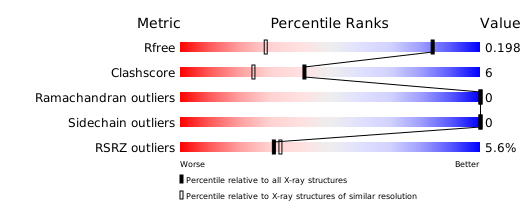
Download full validation report


