






 8VMK
8VMK
A crystal structure of heme-dependent tyrosine hydroxylase complexed with a substrate analog, 3-(4-hydroxyphenyl)propionic acid
Summary for 8VMK
| Entry DOI | 10.2210/pdb8vmk/pdb |
| Descriptor | Heme-dependent L-tyrosine hydroxylase, HYDROXYPHENYL PROPIONIC ACID, PROTOPORPHYRIN IX CONTAINING FE, ... (5 entities in total) |
| Functional Keywords | tyrosine hydroxylase, heme enzyme, binary complex, oxidoreductase, oxidoreductase-inhibitor complex, oxidoreductase/inhibitor |
| Biological source | Streptomyces sclerotialus |
| Total number of polymer chains | 2 |
| Total formula weight | 71055.79 |
| Authors | Wang, Y.,Traore, E.,Liu, A. (deposition date: 2024-01-13, release date: 2025-08-27, Last modification date: 2026-08-12) |
| Primary citation | Traore, E.S.,Wang, Y.,Griffith, W.P.,Liu, A. Substrate Analogs Implicate a Free Radical Pathway in Tyrosine Hydroxylase Catalysis. Acs Catalysis, 15:18270-18281, 2025 Cited by PubMed Abstract: Heme-dependent tyrosine hydroxylases (TyrH) are critical enzymes in catecholamine biosynthesis, yet the role of the substrate's -amino group in their monooxygenation mechanism has been unclear. Using 3-(4-hydroxyphenyl)propionic acid (HPPA), an l-tyrosine analog lacking the -amino group, we observed a distinct dimerization pathway that competes with the expected hydroxylation reaction. Several lines of evidence confirm that this process originates from a radical intermediate. First, the formation of this (HPPA) dimer is selectively inhibited by a free radical scavenger. Second, O-labeling experiments show phenolic oxygen scrambling, indicating a disruption of substrate aromaticity during catalysis. Finally, EPR spectroscopy using nitrosobenzene as a substrate analog revealed a substrate-based free radical. This mechanistic divergence clarifies the role of the -amino group. Its absence in HPPA creates a kinetic bottleneck for the final O atom transfer step, allowing a fraction of the substrate radical to form the off-pathway dimer. Thus, the native substrate's -amino group acts as a crucial kinetic modulator, ensuring the rapid and efficient commitment of the substrate radical to productive hydroxylation. These results collectively establish a peroxidase-like free radical pathway for TyrH and reveal the nonessential yet significant role the amino group plays in controlling reaction outcomes. PubMed: 41737883DOI: 10.1021/acscatal.5c05776 PDB entries with the same primary citation |
| Experimental method | X-RAY DIFFRACTION (1.56 Å) |
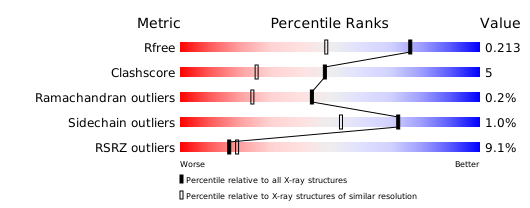
Structure validation
Download full validation report


