






 8VEZ
8VEZ
De novo design apixaban-binding protein: apx1049
Summary for 8VEZ
| Entry DOI | 10.2210/pdb8vez/pdb |
| Descriptor | De novo design apixaban-binding protein: apx1049, 1-(4-METHOXYPHENYL)-7-OXO-6-[4-(2-OXOPIPERIDIN-1-YL)PHENYL]-4,5,6,7-TETRAHYDRO-1H-PYRAZOLO[3,4-C]PYRIDINE-3-CARBOXAMIDE (3 entities in total) |
| Functional Keywords | protein design, deep learning, small-molecule-binding, de novo design, apixaban, de novo protein |
| Biological source | synthetic construct |
| Total number of polymer chains | 1 |
| Total formula weight | 13557.74 |
| Authors | Bera, A.K.,Lee, G.R.,Baker, D. (deposition date: 2023-12-20, release date: 2025-01-15, Last modification date: 2026-07-08) |
| Primary citation | Lee, G.R.,Pellock, S.J.,Norn, C.,Tischer, D.,Dauparas, J.,Anishchenko, I.,Mercer, J.A.M.,Kang, A.,Bera, A.K.,Nguyen, H.,Brackenbrough, E.,Sankaran, B.,Goreshnik, I.,Vafeados, D.,Roullier, N.,Han, H.L.,Coventry, B.,Haddox, H.K.,Liu, D.R.,Yeh, A.H.,Baker, D. Small-molecule binding and sensing with a designed protein family. Nat Commun, 17:-, 2026 Cited by PubMed Abstract: The de novo design of small-molecule-binding proteins holds great promise as a potential tool to develop sensors on-demand for arbitrary small molecules. Here we combine deep learning and physics-based methods to generate a family of proteins with diverse and designable pocket geometries, which we employ to computationally design binders for six small-molecule targets. Biophysical characterization of the designed binders reveals nanomolar to low micromolar binding affinities and atomic-level design accuracy. Additionally, we use a cortisol binder to design a chemically induced dimerization (CID) system that enables the construction of a biosensor for cortisol detection. The approach described here demonstrates the potential of the NTF2 fold and deep learning-based protein design in sensor development, paving the way for future platforms to design binders and sensors for small molecules across analytical, environmental, and biomedical applications. PubMed: 41904144DOI: 10.1038/s41467-026-70953-8 PDB entries with the same primary citation |
| Experimental method | X-RAY DIFFRACTION (2.15 Å) |
Structure validation
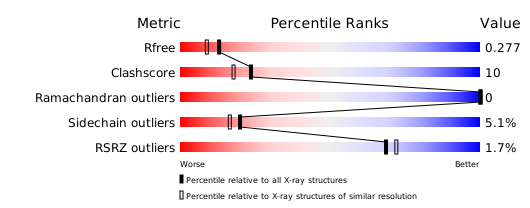
Download full validation report


