






 8UWM
8UWM
FphE, Staphylococcus aureus fluorophosphonate-binding serine hydrolases E, borolane-based compound Q41 bound
Summary for 8UWM
| Entry DOI | 10.2210/pdb8uwm/pdb |
| Descriptor | Fluorophosphonate-binding serine hydrolase E, 2-methyl-4-(4,4,5,5-tetramethyl-1,3,2-dioxaborolan-2-yl)benzene-1-sulfonamide, CALCIUM ION, ... (4 entities in total) |
| Functional Keywords | fphe, staphylococcus aureus, s. aureus, fluorophosphonate-binding, serine hydrolases, lipase, borolane, covalent, boron-serine, boron-histidine, hydrolase |
| Biological source | Staphylococcus aureus subsp. aureus USA300 |
| Total number of polymer chains | 2 |
| Total formula weight | 63304.87 |
| Authors | Fellner, M. (deposition date: 2023-11-06, release date: 2024-11-20, Last modification date: 2025-06-25) |
| Primary citation | Upadhyay, T.,Woods, E.C.,Dela Ahator, S.,Julin, K.,Faucher, F.F.,Uddin, M.J.,Hollander, M.J.,Pedowitz, N.J.,Abegg, D.,Hammond, I.,Eke, I.E.,Wang, S.,Chen, S.,Bennett, J.M.,Jo, J.,Lentz, C.S.,Adibekian, A.,Fellner, M.,Bogyo, M. Identification of covalent inhibitors of Staphylococcus aureus serine hydrolases important for virulence and biofilm formation. Nat Commun, 16:5046-5046, 2025 Cited by PubMed Abstract: Staphylococcus aureus is a leading cause of bacteria-associated mortality worldwide. New tools are needed to both image and treat this pathogen. We previously identified a group of S. aureus serine hydrolases (Fphs), which regulate aspects of virulence and lipid metabolism. However, due to high structural and functional similarities, it remains challenging to distinguish the specific roles of members of this family. Here, we apply a high-throughput screening approach using a library of covalent electrophiles to identify inhibitors for FphB, FphE, and FphH. We identify selective covalent inhibitors for each target without the need for extensive medicinal chemistry optimization. Structural and biochemical analysis identify novel binding modes for several of the inhibitors. Functional studies using the inhibitors suggest that all three hydrolases likely play distinct functional roles in biofilm formation and virulence. This approach has the potential to be applied to target hydrolases in other diverse pathogens or higher eukaryotes. PubMed: 40447595DOI: 10.1038/s41467-025-60367-3 PDB entries with the same primary citation |
| Experimental method | X-RAY DIFFRACTION (1.97 Å) |
Structure validation
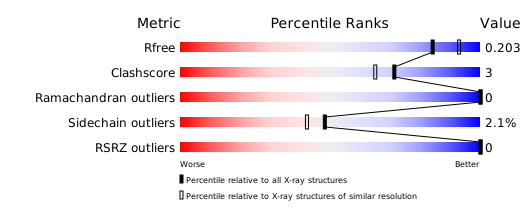
Download full validation report


