






 8URG
8URG
Human mitochondrial calcium uniporter crystal structure (residues 74-165 resolved) with lithium
Summary for 8URG
| Entry DOI | 10.2210/pdb8urg/pdb |
| Descriptor | Calcium uniporter protein, mitochondrial (2 entities in total) |
| Functional Keywords | beta-grasp fold, metal transport |
| Biological source | Homo sapiens (human) |
| Total number of polymer chains | 1 |
| Total formula weight | 13880.74 |
| Authors | Grainger, R.,Colussi, D.C.,Noble, M.,Junop, M.,Stathopulos, P.B. (deposition date: 2023-10-25, release date: 2025-01-22, Last modification date: 2025-03-12) |
| Primary citation | Colussi, D.M.,Grainger, R.,Noble, M.,Lake, T.,Junop, M.,Stathopulos, P.B. Disrupting the network of co-evolving amino terminal domain residues relieves mitochondrial calcium uptake inhibition by MCUb. Comput Struct Biotechnol J, 27:190-213, 2025 Cited by PubMed Abstract: The regulatory mechanisms of the mitochondrial calcium uniporter complex (mtCU), the predominant channel mediating calcium (Ca ) flux into the matrix, are critical for bioenergetics and cell fate. The pore-forming components of mtCU are the mitochondrial Ca uniporter (MCU) subunit and the MCU dominant-negative beta (MCUb) subunit. Despite both MCU paralogs having conserved Asp-Ile-Met-Glu motifs responsible for Ca selectivity, MCUb mediates only low Ca conduction and has been characterized as an inhibitory subunit. We previously identified the MCU amino-terminal domain (NTD) as a negative feedback regulator of mtCU upon divalent cation binding but the role of the MCUb-NTD remains unknown. Thus, to gain mechanistic insight into the competing MCU and MCUb functions, we here studied the divalent cation binding properties of the MCU- and MCUb-NTDs that tightly interact within and between tetrameric channels. First, we resolved a high-resolution MCU-NTD crystal structure in the absence of divalent ions at 1.6 Å, using this structure to model the homologous MCUb-NTD. Further, we conducted 1 all-atom molecular dynamics (MD) simulations in the presence and absence of Ca and Mg ions, not only finding increased MCU-NTD stability at high temperatures compared to MCUb-NTD but also discrete Ca-binding sites on the two domains. Remarkably, the distinct Ca binding site on the central α-helix of MCUb-NTD was also identified in a functional sector of co-evolving residues, with either direct mutation to the coordinating residues or mutation to a separate site within the sector disrupting Ca binding and as well as enhancing mitochondrial Ca uptake . Thus, we reveal that matrix Ca binding to both the MCU-NTD and MCUb-NTD promote mtCU inhibition through disparate interaction sites, highlighting the evolution of discrete feedback regulation mechanisms to precisely control mtCU function. PubMed: 40017731DOI: 10.1016/j.csbj.2024.12.007 PDB entries with the same primary citation |
| Experimental method | X-RAY DIFFRACTION (1.63 Å) |
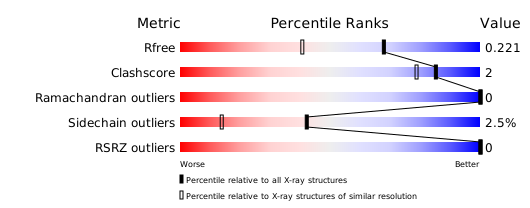
Structure validation
Download full validation report


