






 8UQQ
8UQQ
Structure of mCLIFY: a circularly permuted yellow fluorescent protein
Summary for 8UQQ
| Entry DOI | 10.2210/pdb8uqq/pdb |
| Descriptor | mCLIFY (2 entities in total) |
| Functional Keywords | circular permutation, yellow fluorescence protein, monomer, fluorescent protein |
| Biological source | Aequorea victoria |
| Total number of polymer chains | 1 |
| Total formula weight | 28173.78 |
| Authors | Shweta, H.,Gupta, K.,Zhou, Y.,Cui, X.,Li, S.,Lu, Z.,Goldman, Y.E.,Dantzig, J. (deposition date: 2023-10-24, release date: 2024-10-30, Last modification date: 2026-05-13) |
| Primary citation | Shweta, H.,Gupta, K.,Zhou, Y.,Cui, X.,Li, S.,Lu, Z.,Goldman, Y.E.,Dantzig, J.A. Characterization and structural basis for the brightness of mCLIFY: A novel monomeric and circularly permuted bright yellow fluorescent protein. Biophys.J., 124:2133-2149, 2025 Cited by PubMed Abstract: Ongoing improvements of genetically encoded fluorescent proteins have enhanced cellular localization studies and performance of biosensors, such as environmentally or mechanically sensitive fluorescence resonance energy transfer pairs, in cell biological and biophysical research. The brightest yellow fluorescent protein, widely used in these studies is YPet, derived from the jellyfish Aequorea victoria via the GFP derivative Venus. YPet dimerizes at concentrations used in cellular studies (K = 3.4 μM) which impacts quantitative interpretation of emission intensity, rotational freedom, energy transfer, and lifetime. Although YPet is nearly 30% brighter than Venus, no atomic structures of YPet have been reported to ascertain the structural differences leading to the higher brightness, possibly due to the tendency to dimerize or oligomerize. Here, we report properties of a new YPet derivative, mCLIFY, a monomeric, bright, yellow, and long-lived fluorescent protein created by circular permutation of YPet and substitution of the amino acid residues thought to mediate dimerization. mCLIFY retains the advantageous photophysical properties of YPet but does not dimerize at least up to 40 μM concentration. We determined the atomic structure of mCLIFY at 1.57-Å resolution. Extensive characterization of the photophysical and structural properties of YPet and mCLIFY allowed us to elucidate the bases of their long lifetimes, enhanced brightness, and the difference in propensity to dimerize. PubMed: 40405461DOI: 10.1016/j.bpj.2025.05.012 PDB entries with the same primary citation |
| Experimental method | X-RAY DIFFRACTION (1.57 Å) |
Structure validation
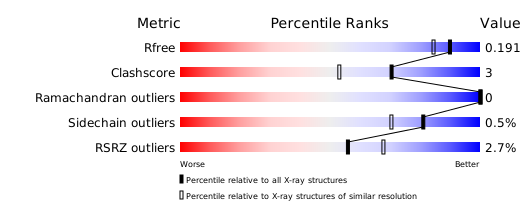
Download full validation report


