






 8UIH
8UIH
anti-Phosphohistidine Fab hSC44.ck.20 with 3pTza peptide
Summary for 8UIH
| Entry DOI | 10.2210/pdb8uih/pdb |
| Descriptor | hSC44.ck.20 Fab heavy chain, hSC44.ck.20 Fab light chain, 3ptza peptide, ... (5 entities in total) |
| Functional Keywords | anti-phosphohistidine antibody post-translational modification antibody humanization, immune system |
| Biological source | Oryctolagus cuniculus More |
| Total number of polymer chains | 3 |
| Total formula weight | 48349.63 |
| Authors | Kalagiri, R.,Stanfield, R.L.,Hunter, T.,Wilson, I.A. (deposition date: 2023-10-10, release date: 2025-03-19, Last modification date: 2026-07-15) |
| Primary citation | Martyn, G.D.,Kalagiri, R.,Veggiani, G.,Stanfield, R.L.,Choudhuri, I.,Sala, M.,Meisenhelder, J.,Chen, C.,Biswas, A.,Levy, R.M.,Lyumkis, D.,Wilson, I.A.,Hunter, T.,Sidhu, S.S. Using phage display for rational engineering of a higher-affinity humanized 3' phosphohistidine-specific antibody. Commun Chem, 8:381-381, 2025 Cited by PubMed Abstract: Histidine phosphorylation is a non-canonical post-translational modification (PTM), with 1-phosphohistidine (1-pHis) and 3-phosphohistidine (3-pHis) isoforms, that is understudied due to a lack of robust reagents, including high-affinity pHis-specific antibodies. Engineering pHis antibodies is challenging due to the labile nature of its phosphoramidate (P-N) bond. We developed a strategy for in vitro engineering of antibodies for the detection of native 3-pHis targets, in which the rabbit SC44-8 anti-3-pTza mAb is humanized into a scaffold (hSC44) that is suitable for phage display. Six unique Fab phage-displayed hSC44 scaffold libraries were screened for antibodies that bound 3-pHis with higher affinity and had specificity for 3-pHis versus 3-pTza. hSC44.20N32F, the best engineered antibody, has ~10-fold higher affinity for 3-pHis than parental hSC44. Eleven new Fab structures, including the first antibody-pHis peptide structures, together with structural and quantum mechanical calculations, provided molecular insights into 3-pHis and 3-pTza discrimination by hSC44.20N32F and the increased affinity obtained through engineering. We demonstrated the utility of these high-affinity 3-pHis-specific antibodies for the recognition of pHis proteins in mammalian cells by immunoblotting and immunofluorescence staining. Our work describes a general method for engineering labile PTM-specific antibodies and provides novel antibodies for investigating the role of 3-pHis in cell biology. PubMed: 41310398DOI: 10.1038/s42004-025-01768-9 PDB entries with the same primary citation |
| Experimental method | X-RAY DIFFRACTION (1.85 Å) |
Structure validation
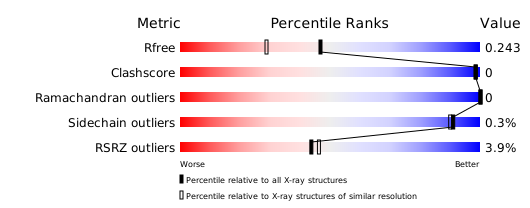
Download full validation report


