






 8UG0
8UG0
Crystal structure of de novo designed metal-controlled heterodimer of mutant B1 immunoglobulin-binding domain of Streptococcal Protein G MCHeT_A + MCHeT_B
Summary for 8UG0
| Entry DOI | 10.2210/pdb8ug0/pdb |
| Descriptor | Beta 1 domain of streptococcal protein G (G beta 1) MCHetA, Beta 1 domain of streptococcal protein G (G beta 1) MCHetB, ZINC ION, ... (5 entities in total) |
| Functional Keywords | de novo, metal binding, heterodimer, de novo protein |
| Biological source | Streptococcus pyogenes More |
| Total number of polymer chains | 2 |
| Total formula weight | 12642.53 |
| Authors | Mealka, M.,Maniaci, B.,Stec, B.,Huxford, T. (deposition date: 2023-10-05, release date: 2024-10-09, Last modification date: 2026-06-17) |
| Primary citation | Maniaci, B.,Mealka, M.,Bobkov, A.A.,Stec, B.,Huxford, T.,Love, J.J. Incorporating Metal-Ligand and Salt-Bridge Interactions in the Design of Protein Heterodimers. Biochemistry, 64:3237-3247, 2025 Cited by PubMed Abstract: The design of chemically controlled asymmetric protein-protein interfaces will further enhance the building of precise protein-based biomaterials. Driving protein-protein interactions through engineered metal-ligand coordination and salt-bridge formation enables the reversible association of two unique binding partners. Creation of precise biomaterial is enhanced through the temporal and chemical control afforded by metal-controlled heterodimeric proteins. In addition, heterodimers enable the specific association of different passenger proteins expressed as fusions to the heterodimeric binding partners. To increase the versatility of protein-based tools, we converted a previously engineered metal-controlled homodimer into a metal-controlled heterodimer. To promote specificity of the heterodimer complex and prevent self-association, it was necessary to incorporate elements of positive and negative design, which was achieved through the incorporation of a cross-interface electrostatic interaction, as well as modifications to hydrophobic contacts at the protein-protein interface. The resulting metal-controlled heterodimer binds with low micromolar affinity, and the crystal structures indicate the presence of the designed dual-interaction motifs at the protein-protein interface. PubMed: 40644321DOI: 10.1021/acs.biochem.5c00108 PDB entries with the same primary citation |
| Experimental method | X-RAY DIFFRACTION (1.43 Å) |
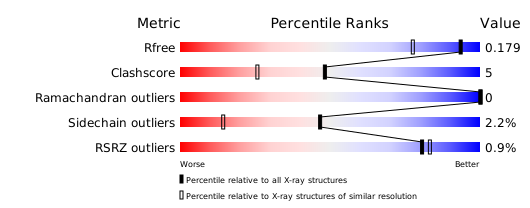
Structure validation
Download full validation report


