






 8TLP
8TLP
Computationally designed tunable C2 symmetric tandem repeat homodimer, D_3_633_8x without peptide
Summary for 8TLP
| Entry DOI | 10.2210/pdb8tlp/pdb |
| Descriptor | D_3_633_8x, no peptide, SULFATE ION (3 entities in total) |
| Functional Keywords | homodimer, de novo, designed, ctrp, computational, c2 symmetric, circular tandem repeat protein, de novo protein |
| Biological source | synthetic construct |
| Total number of polymer chains | 2 |
| Total formula weight | 58300.02 |
| Authors | Kennedy, M.A.,Stoddard, B.L.,Hicks, D.R. (deposition date: 2023-07-27, release date: 2024-12-11, Last modification date: 2026-07-08) |
| Primary citation | Hanna, S.,Salveson, P.J.,Wicky, B.,Kennedy, M.A.,Hicks, D.R.,Moller, C.,Cheng, S.,Li, X.,Abedi, M.,Coventry, B.,Said, M.Y.,Bera, A.K.,Kang, A.,Stoddard, B.L.,Baker, D. De novo design of a macrocycle-induced dimerization system for cellular control. Nat Commun, 2026 Cited by PubMed Abstract: Investigating and manipulating cellular events requires precise control of protein function. To enable control over cellular processes, we set out to design a chemically induced dimerization (CID) system consisting of a de novo-designed ligand and protein pair. Here, we describe the design of a C2 symmetric membrane-permeable macrocyclic peptide and a cognate protein homodimer which binds the macrocycle through a large interface with both chains. The designed homodimer binds the macrocycle with a K of 36 nM, and the x-ray crystal structure of the protein homodimer-macrocycle complex is very close to the computational design model, with the C2 axis of the macrocycle aligned with the homodimer C2 axis. Transcriptional and split luciferase assays in mammalian cells demonstrate conditional control over both a reporter gene expression and luciferase reconstitution. PubMed: 42151133DOI: 10.1038/s41467-026-71345-8 PDB entries with the same primary citation |
| Experimental method | X-RAY DIFFRACTION (2 Å) |
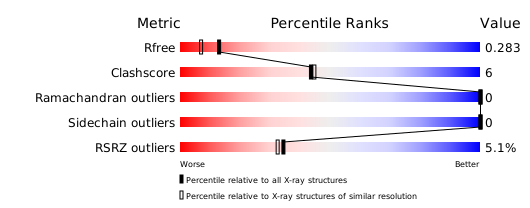
Structure validation
Download full validation report


