






 8TGS
8TGS
The crystal structure of the post-reactive state of UDP-sugar pyrophosphorylase from Leishmania major in complex with product UDP-Glucose and by-product analog VO4 (orthovanadate)
Summary for 8TGS
| Entry DOI | 10.2210/pdb8tgs/pdb |
| Descriptor | UTP-monosaccharide-1-phosphate uridylyltransferase, URIDINE-5'-DIPHOSPHATE-GLUCOSE, VANADATE ION, ... (5 entities in total) |
| Functional Keywords | carbohydrate biosynthesis, nucleotidyltransferase, catalysis, molecular mechanism, sugar binding protein |
| Biological source | Leishmania major |
| Total number of polymer chains | 1 |
| Total formula weight | 67641.43 |
| Authors | Prakash, O.,Fuehring, J.I.,Baruch, P.,Routier, F.H.,Fedorov, R. (deposition date: 2023-07-13, release date: 2025-01-22, Last modification date: 2026-09-02) |
| Primary citation | Prakash, O.,Fuhring, J.,Baruch, P.,Fedorov, R.,Routier, F.H. The post-reactive structures of Leishmania major UDP-sugar pyrophosphorylase provide insights into the product release mechanism. Microbiol Spectr, 13:e0091125-e0091125, 2025 Cited by PubMed Abstract: Biosynthesis of the nucleotide sugars UDP-glucose (UDP-Glc) and UDP-galactose (UDP-Gal) is intimately connected and essential for the viability of trypanosomatid parasites. In the genus , it is controlled by the UDP-glucose pyrophosphorylase (UGP) and UDP-sugar pyrophosphorylase (USP). In contrast to UGP, USP has a broad substrate specificity and may generate several UDP-sugars including UDP-Glc and UDP-Gal. This enzyme, present in protozoan parasites (including species and ) and in plants, most likely plays a role in salvaging monosaccharides. In order to gain a detailed mechanistic understanding of USPs, we determined high-resolution X-ray structures of USP (USP) in post-reactive states. Several positions of the byproduct pyrophosphate (PP) were identified and revealed a product release channel in the forward reaction, as well as the geometries of post-reactive Michaelis product complexes. The conformational changes of functional loops (hinge loop-1, hinge loop-2, and the nucleotide-binding loop) showed dynamic effects accompanying the product release process. Structural information about the post-reactive states of USP also includes the metastable binding position of a magnesium (Mg) ion in the active site. The proposed product release mechanism was substantiated by molecular dynamics simulations and can serve as a model for other UDP-sugar pyrophosphorylases.IMPORTANCETo survive in the hostile environment of the sandfly gut, the parasite relies on a range of phosphoglycans made of mannose-phosphate and galactose. In these glucose-limiting conditions, mannogen potentially serves as a reservoir for the synthesis of these crucial glycoconjugates, whereas galactose likely arises from recycling. The enzyme UDP-sugar pyrophosphorylase (USP) is responsible for the activation of this monosaccharide. This enzyme has a relaxed specificity and converts UTP and a range of sugar-1-phosphate to the corresponding UDP-sugar and pyrophosphate (PP). Here, we determined high-resolution X-ray structures of USP (USP) in post-reactive states. The data provide insight into the product release mechanism for UDP-sugar pyrophosphorylases. Considering the conservation of the residues involved in the coordination of PP amongst USP enzymes, this mechanism is relevant for all USPs. This work completes our knowledge of the catalytic mechanism of trypanosomatid uridylyltransferases, which are genetically validated drug targets. PubMed: 41070952DOI: 10.1128/spectrum.00911-25 PDB entries with the same primary citation |
| Experimental method | X-RAY DIFFRACTION (2.2 Å) |
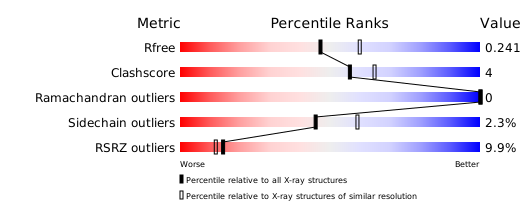
Structure validation
Download full validation report


