






 8RZ8
8RZ8
MutSbeta-ATPgS with straight MSH2 clamp
Summary for 8RZ8
| Entry DOI | 10.2210/pdb8rz8/pdb |
| EMDB information | 19606 |
| Descriptor | DNA mismatch repair protein Msh2, DNA mismatch repair protein Msh3, MAGNESIUM ION, ... (4 entities in total) |
| Functional Keywords | dna repair, mismatch recognition, abc family atpase, dna binding protein |
| Biological source | Homo sapiens (human) More |
| Total number of polymer chains | 2 |
| Total formula weight | 233575.68 |
| Authors | Lee, J.-H.,Thomsen, M.,Daub, H.,Steinbacher, S.,Sztyler, A.,Thieulin-Pardo, G.,Neudegger, T.,Plotnikov, N.,Iyer, R.R.,Wilkinson, H.,Monteagudo, E.,Felsenfeld, D.P.,Haque, T.,Finley, M.,Dominguez, C.,Vogt, T.F.,Prasad, B.C. (deposition date: 2024-02-12, release date: 2024-11-13, Last modification date: 2026-05-27) |
| Primary citation | Lee, J.H.,Thomsen, M.,Daub, H.,Thieulin-Pardo, G.,Steinbacher, S.,Sztyler, A.,Dahiya, V.,Neudegger, T.,Dominguez, C.,Iyer, R.R.,Wilkinson, H.A.,Monteagudo, E.,Plotnikov, N.V.,Felsenfeld, D.P.,Haque, T.S.,Finley, M.,Boudet, J.,Vogt, T.F.,Prasad, B.C. Elucidation of multiple high-resolution states of human MutS beta by cryo-EM reveals interplay between ATP/ADP binding and heteroduplex DNA recognition. Nucleic Acids Res., 53:-, 2025 Cited by PubMed Abstract: Human and mouse genetic studies have demonstrated a role for DNA mismatch repair (MMR) molecular machines in modulating the rate of somatic expansion of the huntingtin (HTT) CAG repeats, and onset and progression of Huntington's Disease (HD). MutSβ, a key component of the MMR pathway, is a heterodimeric protein of MSH2 and MSH3 that recognizes and initiates the repair of extrahelical DNA extrusions. Loss-of-function of mouse Msh3 and reduced-expression alleles of human MSH3 lead to slower rates of somatic expansion and delayed disease onset in humans, signifying MSH3 as a promising therapeutic target for HD. Here we report biochemical and cryo-electron microscopy analyses of human MutSβ, demonstrating MutSβ undergoes conformational changes induced by nucleotide and DNA binding. We present multiple conformations of MutSβ including the DNA-free MutSβ compatible with precisely complementary base-paired homoduplex DNA binding, two distinct structures of MutSβ bound to (CAG)2 DNA, a sliding clamp form and a DNA-unbound, ATP-bound conformation. Along with evidence for novel conformational states adopted by MutSβ to initiate the MMR cascade, these structures provide a foundation for structure-guided drug discovery. PubMed: 40613711DOI: 10.1093/nar/gkaf604 PDB entries with the same primary citation |
| Experimental method | ELECTRON MICROSCOPY (3.06 Å) |
Structure validation
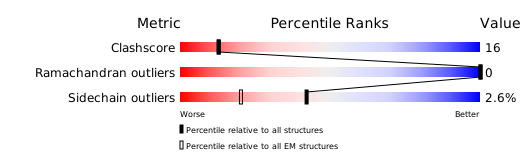
Download full validation report


