






 8RHA
8RHA
HSPB7ACD C131S
Summary for 8RHA
| Entry DOI | 10.2210/pdb8rha/pdb |
| Descriptor | Heat shock protein beta-7 (2 entities in total) |
| Functional Keywords | apo chaperone, chaperone |
| Biological source | Homo sapiens (human) |
| Total number of polymer chains | 3 |
| Total formula weight | 28513.29 |
| Authors | Wang, Z.,Benesch, J.,Allison, T.M.,McDonough, M.A.,Song, H.,Bolla, J.R. (deposition date: 2023-12-15, release date: 2024-10-16, Last modification date: 2025-05-14) |
| Primary citation | Wang, Z.,Cao, G.,Collier, M.P.,Qiu, X.,Broadway-Stringer, S.,Saman, D.,Ng, J.Z.Y.,Sen, N.,Azad, A.J.,Hooper, C.,Zimmermann, J.,McDonough, M.A.,Brem, J.,Rabe, P.,Song, H.,Alderson, T.R.,Schofield, C.J.,Bolla, J.R.,Djinovic-Carugo, K.,Furst, D.O.,Warscheid, B.,Degiacomi, M.T.,Allison, T.M.,Hochberg, G.K.A.,Robinson, C.V.,Gehmlich, K.,Benesch, J.L.P. Filamin C dimerisation is regulated by HSPB7. Nat Commun, 16:4090-4090, 2025 Cited by PubMed Abstract: The biomechanical properties and responses of tissues underpin a variety important of physiological functions and pathologies. In striated muscle, the actin-binding protein filamin C (FLNC) is a key protein whose variants causative for a wide range of cardiomyopathies and musculoskeletal pathologies. FLNC is a multi-functional protein that interacts with a variety of partners, however, how it is regulated at the molecular level is not well understood. Here we investigate its interaction with HSPB7, a cardiac-specific molecular chaperone whose absence is embryonically lethal. We find that FLNC and HSPB7 interact in cardiac tissue under biomechanical stress, forming a strong hetero-dimer whose structure we solve by X-ray crystallography. Our quantitative analyses show that the hetero-dimer out-competes the FLNC homo-dimer interface, potentially acting to abrogate the ability of the protein to cross-link the actin cytoskeleton, and to enhance its diffusive mobility. We show that phosphorylation of FLNC at threonine 2677, located at the dimer interface and associated with cardiac stress, acts to favour the homo-dimer. Conversely, phosphorylation at tyrosine 2683, also at the dimer interface, has the opposite effect and shifts the equilibrium towards the hetero-dimer. Evolutionary analysis and ancestral sequence reconstruction reveals this interaction and its mechanisms of regulation to date around the time primitive hearts evolved in chordates. Our work therefore shows, structurally, how HSPB7 acts as a specific molecular chaperone that regulates FLNC dimerisation. PubMed: 40312381DOI: 10.1038/s41467-025-58889-x PDB entries with the same primary citation |
| Experimental method | X-RAY DIFFRACTION (2.18 Å) |
Structure validation
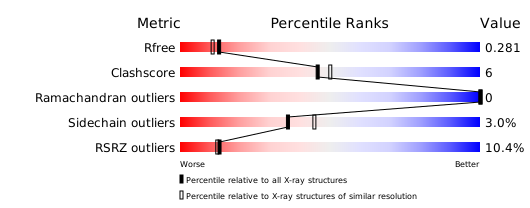
Download full validation report


