






 8R0P
8R0P
Cryo-EM structure of the microbial rhodopsin CryoR2 at pH 8.0 in detergent
Summary for 8R0P
| Entry DOI | 10.2210/pdb8r0p/pdb |
| EMDB information | 18800 |
| Descriptor | microbial rhodopsin CryoR2, EICOSANE, RETINAL, ... (4 entities in total) |
| Functional Keywords | rhodopsin, retinal, cryo-em, light sensor, membrane protein |
| Biological source | Subtercola endophyticus More |
| Total number of polymer chains | 5 |
| Total formula weight | 186179.02 |
| Authors | Kovalev, K.,Marin, E.,Stetsenko, A.,Guskov, A.,Lamm, G.H.U. (deposition date: 2023-10-31, release date: 2025-05-14, Last modification date: 2025-07-16) |
| Primary citation | Lamm, G.H.U.,Marin, E.,Alekseev, A.,Schellbach, A.V.,Stetsenko, A.,Haro-Moreno, J.M.,Bourenkov, G.,Borshchevskiy, V.,Asido, M.,Agthe, M.,Engilberge, S.,Rose, S.L.,Caramello, N.,Royant, A.,Schneider, T.R.,Bateman, A.,Mager, T.,Moser, T.,Rodriguez-Valera, F.,Wachtveitl, J.,Guskov, A.,Kovalev, K. CryoRhodopsins: A comprehensive characterization of a group of microbial rhodopsins from cold environments. Sci Adv, 11:eadv1015-eadv1015, 2025 Cited by PubMed Abstract: Microbial rhodopsins are omnipresent on Earth; however, the vast majority of them remain uncharacterized. Here, we describe a rhodopsin group found in microorganisms from cold environments, such as glaciers, denoted as CryoRhodopsins (CryoRs). A distinguishing feature of the group is the presence of a buried arginine residue close to the cytoplasmic face. Combining single-particle cryo-electron microscopy and x-ray crystallography with rhodopsin activation by light, we demonstrate that the arginine stabilizes an ultraviolet (UV)-absorbing intermediate of an extremely slow CryoRhodopsin photocycle. Together with extensive spectroscopic characterization, our investigations on CryoR1 and CryoR2 proteins reveal mechanisms of photoswitching in the identified group. Our data suggest that CryoRs are sensors for UV irradiation and are also capable of inward proton translocation modulated by UV light. PubMed: 40614199DOI: 10.1126/sciadv.adv1015 PDB entries with the same primary citation |
| Experimental method | ELECTRON MICROSCOPY (2.44 Å) |
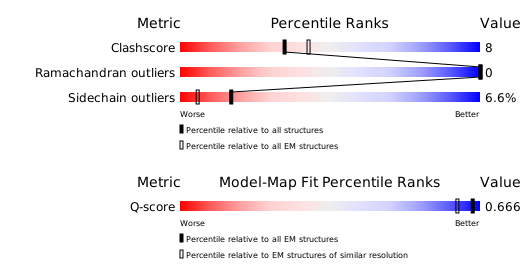
Structure validation
Download full validation report


