






 8R0C
8R0C
Crystal structure of Borneoldehydrogenase ancestor N32
Summary for 8R0C
| Entry DOI | 10.2210/pdb8r0c/pdb |
| Related | 6ZYZ 6ZZ0 6ZZT 7O6Q |
| Descriptor | Borneoldehydrogenase, GLYCEROL (3 entities in total) |
| Functional Keywords | terpenoid, alcohol, oxidoreductase, borneol, rossmann-like fold |
| Biological source | synthetic construct |
| Total number of polymer chains | 4 |
| Total formula weight | 117943.18 |
| Authors | Helmer, C.P.O.,Teijeiro-Juiz, R.,Dimos, N.,Loll, B. (deposition date: 2023-10-31, release date: 2024-10-09, Last modification date: 2026-09-23) |
| Primary citation | Zuson, J.,Helmer, C.P.O.,Di Geronimo, B.,Chanique, A.M.,Kavciakova, K.,Teijeiro-Juiz, R.,Brickel, S.,Ramirez Molina, N.,Drienovska, I.,Kracher, D.,Gaucher, E.A.,Kamerlin, S.C.L.,Loll, B.,Kourist, R. Deciphering the evolutionary origin of the enantioselectivity of short-chain dehydrogenases from plants toward 1-borneol. Nat Commun, 17:-, 2026 Cited by PubMed Abstract: Enzyme engineering has produced numerous methods to optimize enzymes for biotechnological processes; however, less is known about how natural evolution creates new functionalities. We investigate the evolutionary emergence of enantioselectivity in plant borneol dehydrogenases, which feature hydrophobic active-sites and are enantioselective towards dibornane-type monoterpenols. Ancestral sequence reconstruction provided a trajectory from the oldest unselective ancestor N30 (E = 12) toward a more recent selective ancestor N32, involving 19 mutations: 18 mutations are peripheral, one (I111L) occurs in the active-site. The mutation L111I in the hydrophobic pocket increased the selectivity of N30, while the back-mutation I111L decreased the selectivity of N32. Additional peripheral mutations (V136L/G169A/V183I) were required for high selectivity. Crystal structures suggested that protein dynamics rather than structural changes shape these catalytic properties; this was confirmed by Machine Learning/Molecular Mechanics simulations of ligand binding. Funnel-metadynamics simulations revealed a correlation between the active-site's solvent-accessible surface area and selectivity. This potential evolutionary pathway shapes enantioselectivity, and guides future enzyme engineering campaigns. PubMed: 42744776DOI: 10.1038/s41467-026-76435-1 PDB entries with the same primary citation |
| Experimental method | X-RAY DIFFRACTION (1.99 Å) |
Structure validation
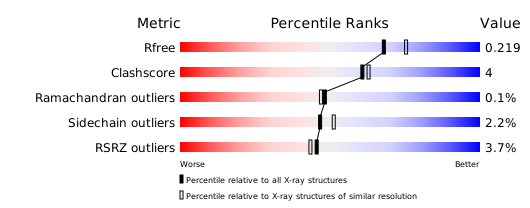
Download full validation report


