






 8HRV
8HRV
dutpase of helicobacter pylori 26695
Summary for 8HRV
| Entry DOI | 10.2210/pdb8hrv/pdb |
| Descriptor | Deoxyuridine 5'-triphosphate nucleotidohydrolase, 2'-DEOXYURIDINE 5'-ALPHA,BETA-IMIDO-TRIPHOSPHATE, MAGNESIUM ION, ... (5 entities in total) |
| Functional Keywords | complex, hydrolase |
| Biological source | Helicobacter pylori 26695 (Campylobacter pylori) |
| Total number of polymer chains | 3 |
| Total formula weight | 51702.68 |
| Authors | Kumari, K.,Gourinath, S. (deposition date: 2022-12-16, release date: 2024-01-17, Last modification date: 2025-03-26) |
| Primary citation | Kumari, K.,Aggarwal, S.,Khan, F.M.,Munde, M.,Gourinath, S. Structural analysis of dUTPase from Helicobacter pylori reveals unusual activity for dATP. Int.J.Biol.Macromol., 282:136937-136937, 2024 Cited by PubMed Abstract: Helicobacter pylori deoxyuridine triphosphate nucleotidohydrolase (HpdUTPase) is a key enzyme in the synthesis of the thymidine nucleotide pathway. It catalyzes the hydrolysis of dUTP to dUMP and releases pyrophosphate. This enzyme has been shown to be essential in several pathogenic organisms. Here, we have determined the crystal structures of HpdUTPase in complex with α, β-imido dUTP (non-hydrolyzable substrate analog) and apo-state at resolution of 2 Å and 2.5 Å respectively. The flexible c terminal end of HpdUTPase which is not observed in apo-state structure and becomes ordered in the complex structure, suggesting its role in forming active site and substrate interaction. The Isothermal titration calorimetry (ITC) experiments reveal that hydrolysis of dUTP is an exothermic reaction with K = 35.0 ± 0.19 μM and the k = 1.20 ± 0.19 s. The ITC studies combined with MD simulations for all other nucleotides (dATP.dGTP, dCTP and dTTP) show that the active site of HpdUTPase strangely can also accommodate dATP. The structural comparison with the host (human) dUTPases reveals critical differences in substrate binding affinity of the active site of HpdUTPase. The detailed study suggests that the dATP binds in the active site of HpdUTPase making the number of preferable hydrogen bonds and shows activity with Km of 47 ± 2.4 μM. PubMed: 39490855DOI: 10.1016/j.ijbiomac.2024.136937 PDB entries with the same primary citation |
| Experimental method | X-RAY DIFFRACTION (2 Å) |
Structure validation
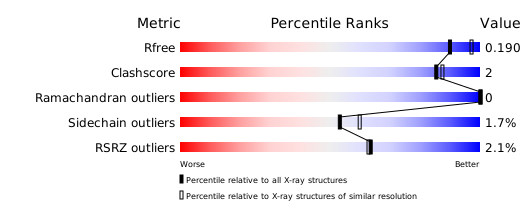
Download full validation report


