






 8FPA
8FPA
Structure of a chimeric antibody (Fab) fragment bound to de-N-acetyl polysialic acid (dPSA)
Summary for 8FPA
| Entry DOI | 10.2210/pdb8fpa/pdb |
| Descriptor | Chimeric antibody Fab fragment, Fd chain, Humanized antibody Fab fragment, light chain, 5-amino-3,5-dideoxy-D-glycero-alpha-D-galacto-non-2-ulopyranosonic acid-(2-8)-3,5-dideoxy-5-(propanoylamino)-D-glycero-alpha-D-galacto-non-2-ulopyranosonic acid-(2-8)-3,5-dideoxy-5-(propanoylamino)-D-glycero-alpha-D-galacto-non-2-ulopyranosonic acid-(2-9)-3,5-dideoxy-5-propanamido-D-glycero-D-galacto-non-2-ulosonic acid, ... (7 entities in total) |
| Functional Keywords | antibody, fab, polysialic acid, complex, immune system |
| Biological source | Mus musculus (mouse) More |
| Total number of polymer chains | 4 |
| Total formula weight | 100061.49 |
| Authors | Beernink, P.T.,Agirre, J.,Beernink, B.P.,Moe, G.R. (deposition date: 2023-01-04, release date: 2026-03-18, Last modification date: 2026-09-30) |
| Primary citation | Moe, G.R.,Agirre, J.,Beernink, P.T. Structure of a MenB de-N-acetyl polysialic acid antibody and mechanism of immune cell inhibition. J.Biol.Chem., 302:113249-113249, 2026 Cited by PubMed Abstract: The Neisseria meningitidis serogroup B (MenB) polysaccharide, α(2-8) polysialic acid (polySia), is essential for resistance to complement-mediated bacteriolysis and inhibition of opsonophagocytosis. The monoclonal antibody SEAM 3 binds de-N-acetyl polySia (dPSA) but not polySia, yet still recognizes encapsulated MenB, indicating the capsule contains dPSA derivatives. Since SEAM 3 also recognizes other pathogens as well as human cancers, we have explored its biological role and mapped the SEAM 3 epitope. We compared binding of N-acetylated and de-N-acetylated polySia and ganglioside GD3 derivatives to sialic-acid-binding immunoglobulin-like lectins (Siglecs) on leukocytes. Siglec-9 showed higher affinity for dPSA and de-N-acetyl GD3 (K ∼2.6-3.1 nM) than for their acetylated counterparts, while Siglec-5 bound polySia and GD3 derivatives with similar and moderate (K∼40-60 nM and 7.9 nM, respectively) affinity. Siglecs-2, -3, -7, -10, and -11 showed negligible binding. T cells, NK cells, and monocytes incubated with live dPSA-expressing MenB acquired dPSA and bacterial protein. A lipophilic dPSA derivative also suppressed endotoxin-induced secretion of IL-1β, IL-6, and TNFα from human peripheral blood mononuclear cells. To map the SEAM 3 epitope, we co-crystallized a humanized SEAM 3 Fab with a dPSA derivative, resolving the structure at 1.83 Å (Rfree = 0.230) with good geometry. The epitope comprises four residues, with a de-N-acetylated residue at the non-reducing end. These findings suggest that dPSA may help mediate MenB immune evasion by engaging the inhibitory Siglec receptors 5 and 9 and confirm the utility of SEAM 3 as a structural probe of dPSA biology and the role of Siglecs in MenB pathogenesis. PubMed: 42285517DOI: 10.1016/j.jbc.2026.113249 PDB entries with the same primary citation |
| Experimental method | X-RAY DIFFRACTION (1.83 Å) |
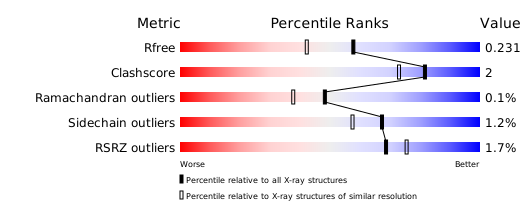
Structure validation
Download full validation report


