






 8BAA
8BAA
CryoEM structure of GroEL-GroES-ADP.AlF3-Rubisco, class II.
This is a non-PDB format compatible entry.
Summary for 8BAA
| Entry DOI | 10.2210/pdb8baa/pdb |
| EMDB information | 15944 |
| Descriptor | Chaperonin GroEL, Co-chaperonin GroES, Ribulose bisphosphate carboxylase, ... (7 entities in total) |
| Functional Keywords | groel, groes, chaperone |
| Biological source | Escherichia coli (strain K12) More |
| Total number of polymer chains | 22 |
| Total formula weight | 932175.15 |
| Authors | Gardner, S.,Saibil, H.R. (deposition date: 2022-10-11, release date: 2025-02-12, Last modification date: 2026-09-02) |
| Primary citation | Gardner, S.,Darrow, M.C.,Lukoyanova, N.,Thalassinos, K.,Saibil, H.R. Structural basis of substrate progression through the bacterial chaperonin cycle. Proc.Natl.Acad.Sci.USA, 120:e2308933120-e2308933120, 2023 Cited by PubMed Abstract: The bacterial chaperonin GroEL-GroES promotes protein folding through ATP-regulated cycles of substrate protein binding, encapsulation, and release. Here, we have used cryoEM to determine structures of GroEL, GroEL-ADP·BeF, and GroEL-ADP·AlF-GroES all complexed with the model substrate Rubisco. Our structures provide a series of snapshots that show how the conformation and interactions of non-native Rubisco change as it proceeds through the GroEL-GroES reaction cycle. We observe specific charged and hydrophobic GroEL residues forming strong initial contacts with non-native Rubisco. Binding of ATP or ADP·BeF to GroEL-Rubisco results in the formation of an intermediate GroEL complex displaying striking asymmetry in the ATP/ADP·BeF-bound ring. In this ring, four GroEL subunits bind Rubisco and the other three are in the GroES-accepting conformation, suggesting how GroEL can recruit GroES without releasing bound substrate. Our cryoEM structures of stalled GroEL-ADP·AlF-Rubisco-GroES complexes show Rubisco folding intermediates interacting with GroEL-GroES via different sets of residues. PubMed: 38064510DOI: 10.1073/pnas.2308933120 PDB entries with the same primary citation |
| Experimental method | ELECTRON MICROSCOPY (4.2 Å) |
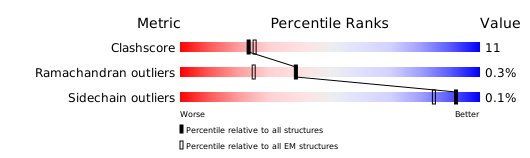
Structure validation
Download full validation report


