






 7BEU
7BEU
Human glutathione transferase M1-1
Summary for 7BEU
| Entry DOI | 10.2210/pdb7beu/pdb |
| Descriptor | Glutathione S-transferase Mu 1, SODIUM ION (3 entities in total) |
| Functional Keywords | glutathione, detoxification, xenobiotics, ligand binding, transferase |
| Biological source | Homo sapiens (Human) |
| Total number of polymer chains | 4 |
| Total formula weight | 103148.30 |
| Authors | Papageorgiou, A.C.,Poudel, N. (deposition date: 2020-12-28, release date: 2022-01-12, Last modification date: 2024-01-31) |
| Primary citation | Bodourian, C.S.,Poudel, N.,Papageorgiou, A.C.,Antoniadi, M.,Georgakis, N.D.,Abe, H.,Labrou, N.E. Ligandability Assessment of Human Glutathione Transferase M1-1 Using Pesticides as Chemical Probes. Int J Mol Sci, 23:-, 2022 Cited by PubMed Abstract: Glutathione transferases (GSTs; EC 2.5.1.18) form a group of multifunctional enzymes that are involved in phase II of the cellular detoxification mechanism and are associated with increased susceptibility to cancer development and resistance to anticancer drugs. The present study aims to evaluate the ligandability of the human GSTM1-1 isoenzyme (hGSTM1-1) using a broad range of structurally diverse pesticides as probes. The results revealed that hGSTM1-1, compared to other classes of GSTs, displays limited ligandability and ligand-binding promiscuity, as revealed by kinetic inhibition studies. Among all tested pesticides, the carbamate insecticide pirimicarb was identified as the strongest inhibitor towards hGSTM1-1. Kinetic inhibition analysis showed that pirimicarb behaved as a mixed-type inhibitor toward glutathione (GSH) and 1-chloro-2,4-dinitrobenzene (CDNB). To shine a light on the restricted hGSTM1-1 ligand-binding promiscuity, the ligand-free crystal structure of hGSTM1-1 was determined by X-ray crystallography at 1.59 Å-resolution. Comparative analysis of ligand-free structure with the available ligand-bound structures allowed for the study of the enzyme's plasticity and the induced-fit mechanism operated by hGSTM1-1. The results revealed important structural features of the H-site that contribute to xenobiotic-ligand binding and specificity. It was concluded that hGSTM1-1 interacts preferentially with one-ring aromatic compounds that bind at a discrete site which partially overlaps with the xenobiotic substrate binding site (H-site). The results of the study form a basis for the rational design of new drugs targeting hGSTM1-1. PubMed: 35408962DOI: 10.3390/ijms23073606 PDB entries with the same primary citation |
| Experimental method | X-RAY DIFFRACTION (1.59 Å) |
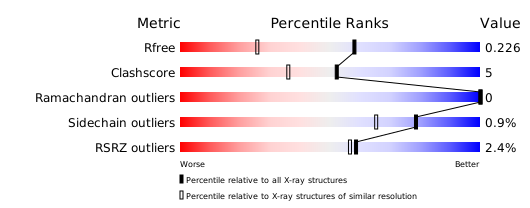
Structure validation
Download full validation report


