






 6WES
6WES
Crystal structure of the effector SnTox3 from Parastagonospora nodorum
Summary for 6WES
| Entry DOI | 10.2210/pdb6wes/pdb |
| Descriptor | Tox3 (2 entities in total) |
| Functional Keywords | fungal effector, beta barrel, disulfide bond, toxin |
| Biological source | Phaeosphaeria nodorum (strain SN15 / ATCC MYA-4574 / FGSC 10173) (Glume blotch fungus) |
| Total number of polymer chains | 1 |
| Total formula weight | 17896.25 |
| Authors | Outram, M.A.,Williams, S.J.,Ericsson, D.J.,Kobe, B.,Solomon, P.S. (deposition date: 2020-04-02, release date: 2020-11-04, Last modification date: 2024-11-13) |
| Primary citation | Outram, M.A.,Sung, Y.C.,Yu, D.,Dagvadorj, B.,Rima, S.A.,Jones, D.A.,Ericsson, D.J.,Sperschneider, J.,Solomon, P.S.,Kobe, B.,Williams, S.J. The crystal structure of SnTox3 from the necrotrophic fungus Parastagonospora nodorum reveals a unique effector fold and provides insight into Snn3 recognition and pro-domain protease processing of fungal effectors. New Phytol., 231:2282-2296, 2021 Cited by PubMed Abstract: Plant pathogens cause disease through secreted effector proteins, which act to promote infection. Typically, the sequences of effectors provide little functional information and further targeted experimentation is required. Here, we utilized a structure/function approach to study SnTox3, an effector from the necrotrophic fungal pathogen Parastagonospora nodorum, which causes cell death in wheat-lines carrying the sensitivity gene Snn3. We developed a workflow for the production of SnTox3 in a heterologous host that enabled crystal structure determination and functional studies. We show this approach can be successfully applied to study effectors from other pathogenic fungi. The β-barrel fold of SnTox3 is a novel fold among fungal effectors. Structure-guided mutagenesis enabled the identification of residues required for Snn3 recognition. SnTox3 is a pre-pro-protein, and the pro-domain of SnTox3 can be cleaved in vitro by the protease Kex2. Complementing this, an in silico study uncovered the prevalence of a conserved motif (LxxR) in an expanded set of putative pro-domain-containing fungal effectors, some of which can be cleaved by Kex2 in vitro. Our in vitro and in silico study suggests that Kex2-processed pro-domain (designated here as K2PP) effectors are common in fungi and this may have broad implications for the approaches used to study their functions. PubMed: 34053091DOI: 10.1111/nph.17516 PDB entries with the same primary citation |
| Experimental method | X-RAY DIFFRACTION (1.36 Å) |
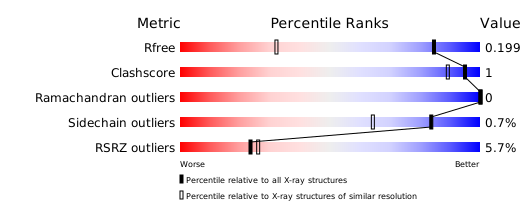
Structure validation
Download full validation report


