






 6UTU
6UTU
Crystal structure of minor pseudopilin ternary complex of XcpVWX from the Type 2 secretion system of Pseudomonas aeruginosa in the P3 space group
Summary for 6UTU
| Entry DOI | 10.2210/pdb6utu/pdb |
| Descriptor | Type II secretion system protein I, Type II secretion system protein J, Type II secretion system protein K, ... (5 entities in total) |
| Functional Keywords | pseudopilus, minor pseduopilin, protein transport |
| Biological source | Pseudomonas aeruginosa (strain ATCC 15692 / DSM 22644 / CIP 104116 / JCM 14847 / LMG 12228 / 1C / PRS 101 / PAO1) More |
| Total number of polymer chains | 9 |
| Total formula weight | 190545.91 |
| Authors | |
| Primary citation | Zhang, Y.,Wang, S.,Jia, Z. In Situ Proteolysis Condition-Induced Crystallization of the XcpVWX Complex in Different Lattices. Int J Mol Sci, 21:-, 2020 Cited by PubMed Abstract: Although prevalent in the determination of protein structures; crystallography always has the bottleneck of obtaining high-quality protein crystals for characterizing a wide range of proteins; especially large protein complexes. Stable fragments or domains of proteins are more readily to crystallize; which prompts the use of in situ proteolysis to remove flexible or unstable structures for improving crystallization and crystal quality. In this work; we investigated the effects of in situ proteolysis by chymotrypsin on the crystallization of the XcpVWX complex from the Type II secretion system of . Different proteolysis conditions were found to result in two distinct lattices in the same crystallization solution. With a shorter chymotrypsin digestion at a lower concentration; the crystals exhibited a P3 hexagonal lattice that accommodates three complex molecules in one asymmetric unit. By contrast; a longer digestion with chymotrypsin of a 10-fold higher concentration facilitated the formation of a compact P222 orthorhombic lattice with only one complex molecule in each asymmetric unit. The molecules in the hexagonal lattice have shown high atomic displacement parameter values compared with the ones in the orthorhombic lattice. Taken together; our results clearly demonstrate that different proteolysis conditions can result in the generation of distinct lattices in the same crystallization solution; which can be exploited in order to obtain different crystal forms of a better quality. PubMed: 31906428DOI: 10.3390/ijms21010308 PDB entries with the same primary citation |
| Experimental method | X-RAY DIFFRACTION (2.85 Å) |
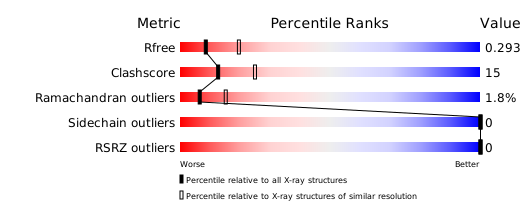
Structure validation
Download full validation report


