






 5MRA
5MRA
human SCBD (sorcin calcium binding domain) in complex with doxorubicin
Summary for 5MRA
| Entry DOI | 10.2210/pdb5mra/pdb |
| Descriptor | Sorcin, MAGNESIUM ION, DIMETHYL SULFOXIDE, ... (5 entities in total) |
| Functional Keywords | sorcin (soluble resistance-related calcium binding protein), metal binding protein |
| Biological source | Homo sapiens (Human) |
| Cellular location | Cytoplasm: P30626 |
| Total number of polymer chains | 4 |
| Total formula weight | 76258.02 |
| Authors | Ilari, A.,Fiorillo, A.,Colotti, G.,Genovese, I. (deposition date: 2016-12-22, release date: 2017-11-29, Last modification date: 2024-01-17) |
| Primary citation | Genovese, I.,Fiorillo, A.,Ilari, A.,Masciarelli, S.,Fazi, F.,Colotti, G. Binding of doxorubicin to Sorcin impairs cell death and increases drug resistance in cancer cells. Cell Death Dis, 8:e2950-e2950, 2017 Cited by PubMed Abstract: Sorcin is a calcium binding protein that plays an important role in multidrug resistance (MDR) in tumors, since its expression confers resistance to doxorubicin and to other chemotherapeutic drugs. In this study, we show that Sorcin is able to bind doxorubicin, vincristine, paclitaxel and cisplatin directly and with high affinity. The high affinity binding of doxorubicin to sorcin has been demonstrated with different techniques, that is, surface plasmon resonance, fluorescence titration and X-ray diffraction. Although the X-ray structure of sorcin in complex with doxorubicin has been solved at low resolution, it allows the identification of one of the two doxorubicin binding sites, placed at the interface between the EF5 loop the G helix and the EF4 loop. We show that Sorcin cellular localization changes upon doxorubicin treatment, an indication that the protein responds to doxorubicin and it presumably binds the drug also inside the cell, soon after drug entrance. We also demonstrate that Sorcin is able to limit the toxic effects of the chemotherapeutic agent in the cell. In addition, Sorcin silencing increases cell death upon treatment with doxorubicin, increases the accumulation of doxorubicin in cell nucleus, decreases the expression of MDR1 and doxorubicin efflux via MDR1. PubMed: 28726784DOI: 10.1038/cddis.2017.342 PDB entries with the same primary citation |
| Experimental method | X-RAY DIFFRACTION (3.74 Å) |
Structure validation
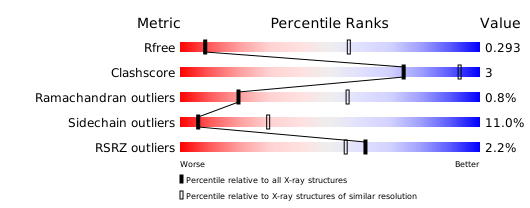
Download full validation report


